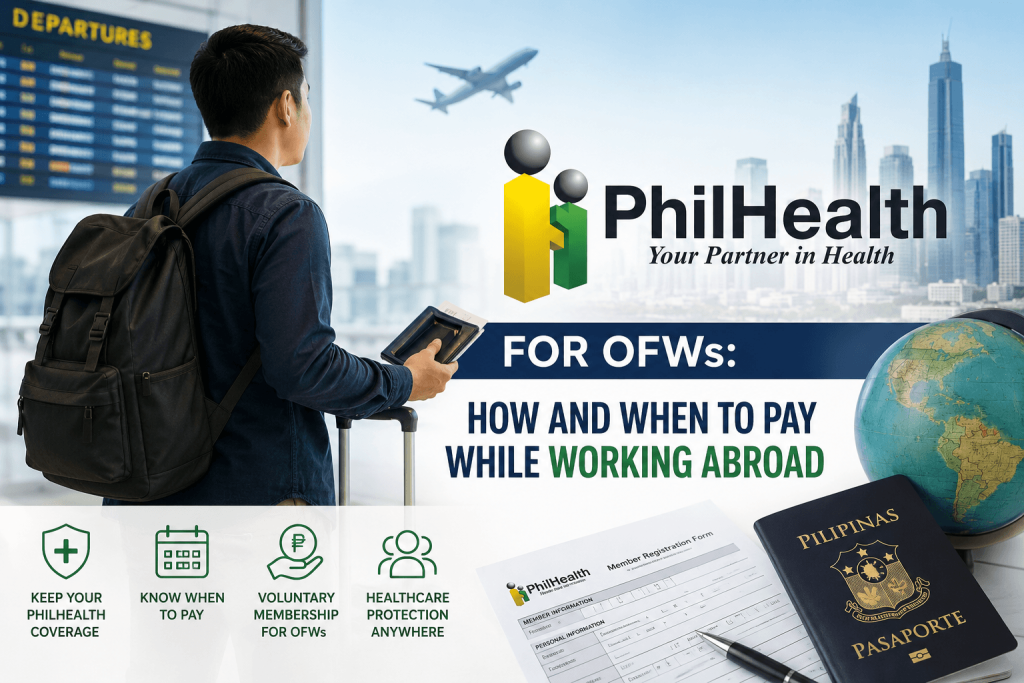
PhilHealth OFW Payment: How and When to Pay While Working Abroad
What OFWs actually need to know about PhilHealth — current rate, the real (and more complicated) OEC situation, payment options abroad, and how to file a reimbursement claim.
Sourced from PhilHealth’s official 2026 rate advisory (via Philippine Information Agency), DMW/OEC requirements, and cross-checked across multiple independent sources, verified July 2026.
If you’re a land-based OFW, PhilHealth isn’t just a formality — it’s tied directly to your ability to legally deploy for work. Here’s what’s actually required, how much you’ll pay, and something most guides skip: the real, ongoing controversy over whether this rate is fair, and where that stands right now.
Yes, It’s Currently Mandatory — But the Full Story Is More Complicated
As of this writing, land-based OFWs are required to pay PhilHealth contributions at the standard 5% rate, same as other self-paying members — this was confirmed as the final rate under the Universal Health Care Act in PhilHealth’s own 2026 advisory.
But here’s the context most articles leave out: in 2020, PhilHealth actually suspended the income-based premium for migrant workers after significant public backlash — OFWs were being charged based on their full overseas salary, which for many meant a steep, sudden increase. Senators including Raffy Tulfo and JV Ejercito have publicly pushed for OFWs to be exempted entirely or have their premiums government-subsidized, and as of early 2026, a House bill proposing to make OFW contributions voluntary was still pending in Congress — it has not passed.
What this means practically: 5% is the current, standing, enforced rule — don’t skip payment assuming it’s optional. But this is genuinely an area of active political dispute, not settled the way, say, the SSS contribution table is. Before paying, it’s worth checking PhilHealth’s latest advisories or asking directly at your DMW/POEA processing, since this is one of the few areas in this entire guide series where the rule could realistically change.

The OEC Requirement: More Complicated Than Most Guides Say
Many guides state flatly that you can’t get your Overseas Employment Certificate (OEC) without updated PhilHealth contributions. This isn’t as settled as it sounds, and getting it wrong here matters.
Here’s the documented history: this requirement was written into the UHC Law’s implementing rules, but in June 2020, PhilHealth’s own president publicly clarified — during a Congressional oversight hearing, following a direct presidential directive — that OFWs are NOT required to pay PhilHealth premiums before securing their OEC.This came after OFW groups protested a premium hike, and the government responded by explicitly decoupling PhilHealth payment from OEC issuance, confirmed by PhilHealth itself.
Since then, the practical situation appears to have shifted again, or at least become inconsistent. Some current guides (2026-dated) describe OEC processing as still requiring updated PhilHealth contributions in practice. This may reflect enforcement being reinstated at some point, inconsistent enforcement across different POEA/DMW processing centers, or simply outdated information being repeated without verification — we couldn’t find an official 2026 circular clearly re-establishing this as a hard requirement, but we also can’t rule out that it’s being enforced informally or regionally.
The responsible thing to do here: don’t assume either way. Confirm the actual current requirement directly at your DMW/POEA processing office when you apply for your OEC, rather than relying on this article, a Facebook group, or any other guide — this is the single most fluid, unsettled detail in the entire article, and it’s worth the extra step of asking directly given how much is riding on your deployment timeline.
If payment before deployment is required at your processing center: the typical initial advance payment historically cited is around ₱2,400 to ₱3,000, with the remaining balance payable quarterly, semi-annually, or after twelve months. Treat this as a rough historical reference, not a guaranteed current figure.
How Much and How Often You Pay
Once deployed, land-based OFWs can pay:
- Annually or semi-annually, through accredited payment centers such as banks or e-wallets — this is more flexible than the standard monthly cadence most other members follow, since remitting monthly from abroad isn’t always practical.
- Based on the standard 5% rate, within the usual ₱500 (minimum) to ₱5,000 (maximum) monthly-equivalent range.
Remember the SPA requirement covered in our self-employed PhilHealth guide also applies to land-based OFWs— you’ll need to generate a Statement of Premium Account before any payment is accepted, effective April 2026. Sea-based OFWs (seafarers) are excluded from this SPA requirement, since their contributions are remitted differently through their manning agency.
Your Dependents Stay Covered While You’re Away
Your qualified dependents back home — spouse, unmarried children under 21, or qualified parents — can continue using PhilHealth benefits while you’re working abroad, as long as your contributions remain current. Your coverage doesn’t pause just because you’re overseas.
If You’re Hospitalized Abroad: How to Claim Reimbursement
Unlike members in the Philippines who typically have their PhilHealth benefit applied directly at an accredited hospital, an OFW hospitalized abroad usually has to pay out of pocket first, then file for reimbursement once documentation is available.
You get significantly more time to file than members do domestically: the standard reimbursement window is 60 days from discharge — but OFWs are given 180 days specifically because of the practical difficulty of filing from abroad.
What you’ll need to file:
- Completed PhilHealth Claim Form 1
- Medical Abstract/Record or Medical Certificate (in English, or officially translated), stating final diagnosis and services rendered
- Copy of the Operative Record, if surgery was involved
- Official Receipt from the hospital and doctor
- A certified true copy of hospital records, and your passport stamp page showing your travel dates
Where to send it: mail or submit documents to the PhilHealth Regional Office or Local Health Insurance Office nearest your Philippine address.
Eligibility check before filing: confirm you have at least 3 monthly contributions within the 6 months before your hospitalization — this is PhilHealth’s standard rule (the “3/6 rule”) covering most general inpatient confinements. Note that a stricter rule applies to specific benefit categories: pregnancy-related case rates, newborn care package, dialysis, chemotherapy, radiotherapy, and select surgical procedures require 9 monthly contributions within the preceding 12 months instead (the “9/12 rule”). If your hospitalization falls into one of these specific categories, check which rule applies to your case before assuming the easier 3/6 threshold covers you. (This PhilHealth 9/12 rule for pregnancy-related case rates is separate from the SSS Maternity Benefit’s own qualifying rule, covered in our SSS maternity guide — the two are independent programs from different agencies with their own requirements.)
FAQs
Is PhilHealth really mandatory for OFWs, or is there a way around it? The payment obligation itself is currently mandatory under law, though enforcement specifically tied to OEC issuance has a documented history of being officially suspended in 2020 — and current enforcement appears inconsistent. Don’t assume either way; verify directly with your DMW/POEA processing office.
Will I be denied my OEC if I haven’t paid PhilHealth? This genuinely depends on current enforcement at your specific processing center — PhilHealth officially decoupled payment from OEC issuance in 2020, but some current sources describe it still being checked in practice. Ask directly during your OEC application rather than assuming either outcome.
What if I already paid before finding out there’s a pending exemption bill? The bill hasn’t passed as of this writing, so current payments remain a legal requirement, not something you can retroactively opt out of. Continue paying under the current rules until any change is officially implemented.
Do sea-based OFWs (seafarers) follow the same rules as land-based OFWs? No — seafarers follow the standard employed-member 50/50 split through their manning agency, not the self-paid 5% rate covered here, and they’re excluded from the SPA payment requirement.
Can I pay my PhilHealth contributions before I even leave the Philippines? Yes — you can pay before departure or while abroad, whichever is more practical for your situation.
What happens to my PhilHealth coverage if I miss payments while working abroad? Missed contributions don’t immediately cut off benefit access, but you’ll need to settle them with interest to bring your account current — the same rule that applies to other self-paying members.
Related guides: PhilHealth for Self-Employed, Freelancers, and Online Sellers · PhilHealth Contribution Table 2026