TIN ID Requirements Philippines 2026: Complete Application Checklist
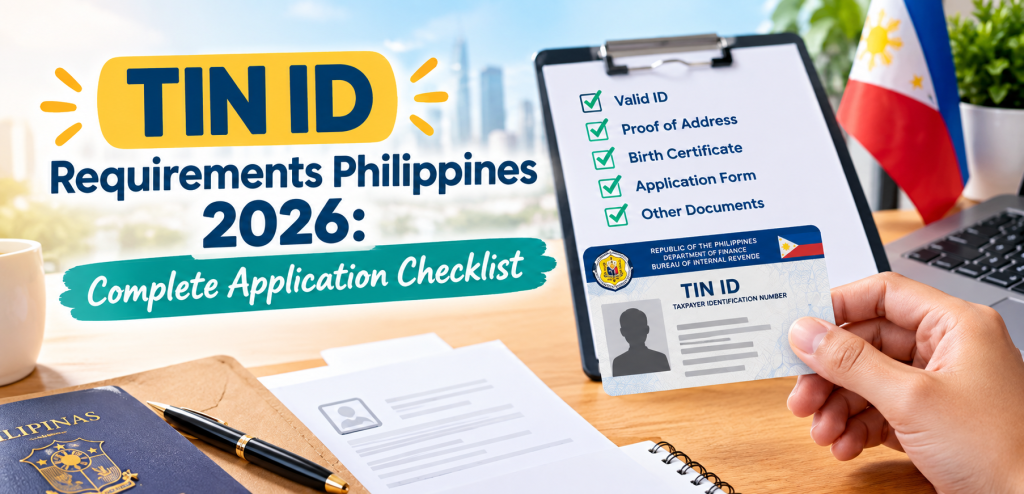
Sourced directly from BIR Revenue Memorandum Circular 120-2023, the current BIR Form 1902 (October 2025 revision), and BIR’s official registration pages, verified July 2026.
Getting your TIN ID shouldn’t require guesswork — but a lot of what’s online about this comes from commercial sites that aren’t actually affiliated with BIR, some using names deliberately similar to BIR’s real system. Here’s the accurate, current process, plus how to tell the real official channel from a lookalike.
Important First: Know the Real Official System
BIR’s actual online registration portal is orus.bir.gov.ph — the Online Registration and Update System. Several commercially-run websites use very similar names but are not operated by BIR. BIR’s own circular explicitly warns taxpayers against using third-party “TIN ID assistance” services, since this risks getting an invalid or fake TIN and incorrect taxpayer classification. Always start at bir.gov.ph or orus.bir.gov.ph directly — never a third-party site, no matter how official it looks.
What a TIN Actually Is
A Taxpayer Identification Number (TIN) is a permanent, system-generated identifier assigned by BIR to every taxpayer. The core TIN is 9 digits; when a 3-digit branch code is appended for business or transaction purposes, it’s sometimes displayed as a 12-character number — but the number itself doesn’t change, and you’re only ever allowed one TIN for life. Registering for a second TIN is criminally punishable under BIR rules — if you’re not sure whether you already have one, verify first rather than applying for a new one.
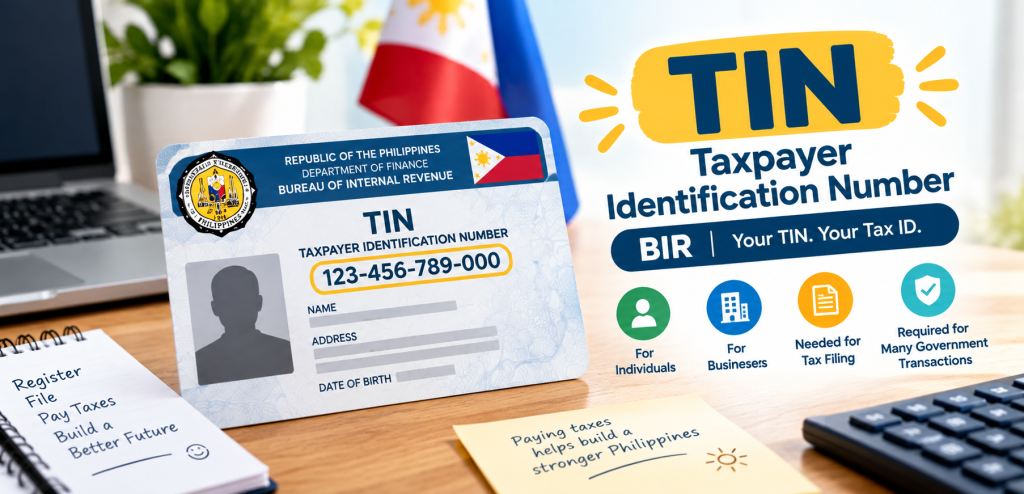
The Digital TIN ID: A Real, Legitimate Option (Not a Forced Replacement)
Since November 2023, BIR has offered the Digital TIN ID as an official alternative to the physical card, introduced under RMC No. 120-2023. To be clear about something several unofficial sites overstate: this is not confirmed as a mandatory replacement for the physical card — it’s a legitimate additional option, and the Digital TIN ID:
- Is legally valid as a government-issued ID under RMC No. 120-2023
- Requires no signature
- Includes a QR code you can scan to verify authenticity directly through ORUS
- Is completely free — BIR explicitly warns that anyone selling “TIN ID processing” services online may hand you an invalid or fake TIN
- Is not a temporary substitute — it carries the same legal weight as a physical card
Genuinely new development worth knowing (confirmed via official channels): as of April 24, 2026, under RMC No. 34-2026, BIR expanded Digital TIN ID access through the eGovPH Mobile App — the Philippine government’s unified digital services platform, developed under DICT oversight. This means you can now access your Digital TIN ID through a government-wide app, not just the ORUS website directly.
Separately, BIR redesigned the physical card itself back in 2023: the old yellow-orange card was discontinued (it had actually already stopped being issued since July 2021) and replaced by a green card under BIR Form 1931 for new physical card requests. If you already have an old yellow-orange card, it remains valid indefinitely — you don’t need to replace it.
Which BIR Form You Need Depends on Your Situation
- BIR Form 1902 — for individuals earning purely compensation income (employees, local or foreign/alien employees starting their first job)
- BIR Form 1901 — for self-employed individuals, freelancers, mixed-income earners, and professionals registering a business or practice
- BIR Form 1904 — for one-time taxpayers and first-time job seekers registering under Executive Order No. 98 (e.g., needing a TIN for a single government transaction, not ongoing employment)
Requirements by Taxpayer Type
Employees (Form 1902):
- Accomplished BIR Form 1902
- Any government-issued ID showing your full name, birthdate, and address (if your ID lacks an address, you may need additional proof of residence)
- Most employers handle this registration on your behalf as part of onboarding — but if your employer doesn’t, you’ll need to register directly through your assigned Revenue District Office (RDO) or ORUS
Self-employed/Freelancers (Form 1901):
- Accomplished BIR Form 1901
- Valid government ID
- Proof of business registration or intent to practice (requirements vary depending on whether you’re registering as a sole proprietor, professional, or mixed-income earner)
First-time job seekers / one-time transactions (Form 1904):
- Accomplished BIR Form 1904 (typically two original copies)
- Valid ID (a PSA birth certificate is commonly requested here)
- Fee exemption: under the First Time Jobseekers Act (RA 11261), first-time job seekers applying for their very first TIN are exempted from government processing fees. To qualify: you must be a Filipino citizen actively seeking employment for the first time (locally or abroad), and a resident of your barangay for at least 6 months. Secure a Barangay Certification for First-Time Job Seekers confirming this — the exemption is valid for 1 year from the certification’s issue date, and can only be used once, for one copy of each covered document (TIN included). If you’ve had any prior formal employment, you generally won’t qualify as “first-time.”
Foreign nationals:
- Passport with valid visa or Alien Certificate of Registration (ACR)
- Employment contract or Certificate of Employment, if employed
- Form 1902 if employed; Form 1904 if registering for a one-time transaction only
How to Register Online Through ORUS
- Go directly to orus.bir.gov.ph.
- Select “Register New Account” and provide your name, email, and contact details.
- Choose your taxpayer type — employee, self-employed, or unemployed/one-time transaction.
- Complete the online form and submit.
- Wait for email confirmation.
- If a physical pickup or in-person step is required for your specific case, bring a valid ID and your printed confirmation to your assigned BIR RDO.
The One Rule That Trips Up the Most Applicants: Your Specific RDO
You cannot pick up documents or transact at just any BIR branch — only at the specific Revenue District Office (RDO) where your TIN is registered. This is a formal, official rule, not just common practice: BIR’s own Revenue Memorandum Order No. 37-2019 explicitly states that TIN card issuance for registered employees must be done at their respective RDO where the taxpayer is registered. If your first job registered you at an RDO in one city and you later move elsewhere, attempting to transact at your new local RDO will typically get you turned away, since that branch has no authorization over a record registered elsewhere.
If you’re not sure which RDO you’re assigned to, confirm it before making a trip — through ORUS, the BIR RDO Finder tool, or by contacting BIR directly. If you’ve genuinely moved and need to update your assigned RDO, this is done via BIR Form 1905 (an RDO transfer), not by applying for a new TIN — you keep the same TIN for life regardless of which RDO you’re currently registered under.
One more concrete detail worth knowing: your very first TIN card is free. If you need a replacement due to loss or damage, BIR charges a ₱100 fee for reissuance.
Common Mistakes That Cause Rejection or Delay
- Registering for a second TIN instead of retrieving/using your existing one — this is a criminal offense, not just an inconvenience.
- Going to the wrong RDO — the single most common reason for a wasted trip, per the pattern above.
- Incomplete or mismatched documents between your ID and your application details.
- Paying a third party for “TIN ID processing” — legitimate registration through BIR is free; anyone charging for basic TIN ID issuance is a red flag.
FAQs
Is getting a TIN ID free? Yes — registering for a TIN and obtaining your Digital TIN ID through BIR’s official channels is free. Be cautious of any third-party site or individual charging a fee for this.
Can I still get a physical TIN card instead of the digital version? Yes — the Digital TIN ID is a legitimate additional option, not a forced replacement. Physical cards (the current green design under Form 1931) are still issued; if you already have an old yellow-orange card, it remains valid indefinitely.
What happens if I accidentally have two TINs? Do not continue using both — possession of more than one TIN is criminally punishable. Contact BIR to consolidate your records rather than ignoring the issue.
Do I need to visit a BIR office in person, or can everything be done online? Much of the process can now start through ORUS online, though certain situations (physical card requests, specific document verification) may still require an in-person visit to your assigned RDO.
How much does it cost to replace a lost or damaged TIN card? Your initial TIN card is free. A replacement due to loss or damage carries a ₱100 fee, per BIR’s official rules.
What if I moved and I’m now registered under the wrong RDO? You don’t need a new TIN — file BIR Form 1905 to formally transfer your registration to your new RDO. Your TIN itself stays the same for life; only the RDO assignment changes.
How is a TIN ID different from a TIN number? The TIN number is the actual 9-digit (or 12-digit with branch code) identifier itself. The TIN ID is the physical or digital card that displays it as a form of identification.