PhilHealth Contribution Table 2026: How Much Should Be Deducted
How much you should be paying PhilHealth in 2026 — the 5% rate breakdown, salary floor and ceiling, and who’s exempt entirely.
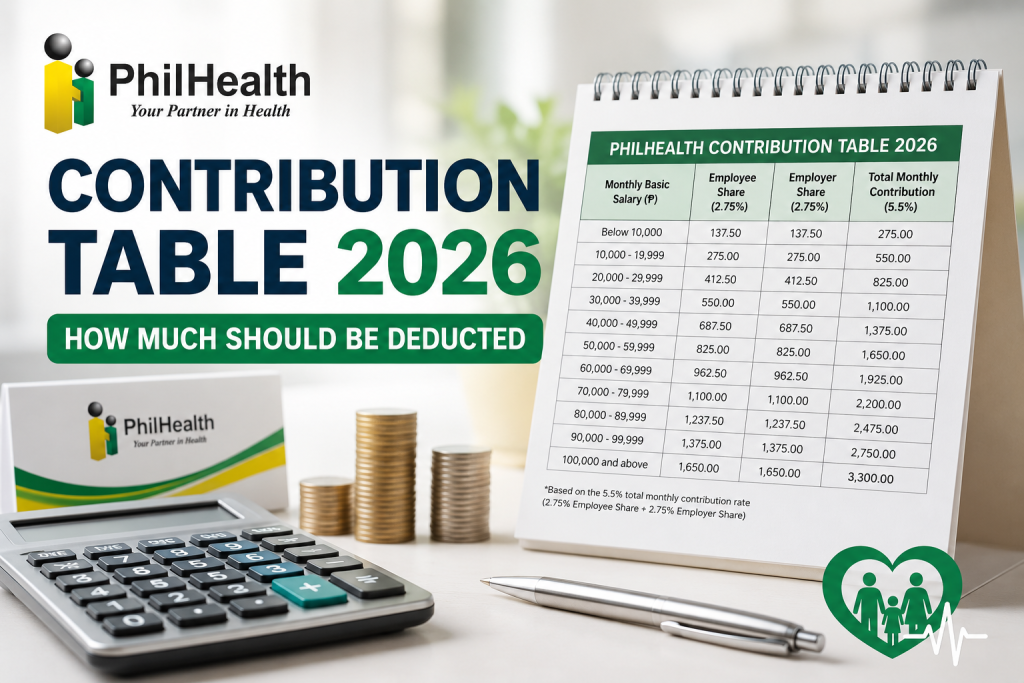
Rates below are confirmed against PhilHealth’s own official contribution schedule (philhealth.gov.ph) and cross-checked across many independent sources, verified July 2026.
Whether you’re an employee checking if your employer deducted the right amount, self-employed and unsure what to declare, or managing a household employee, here’s exactly how much you should be paying PhilHealth in 2026.
The Short Answer
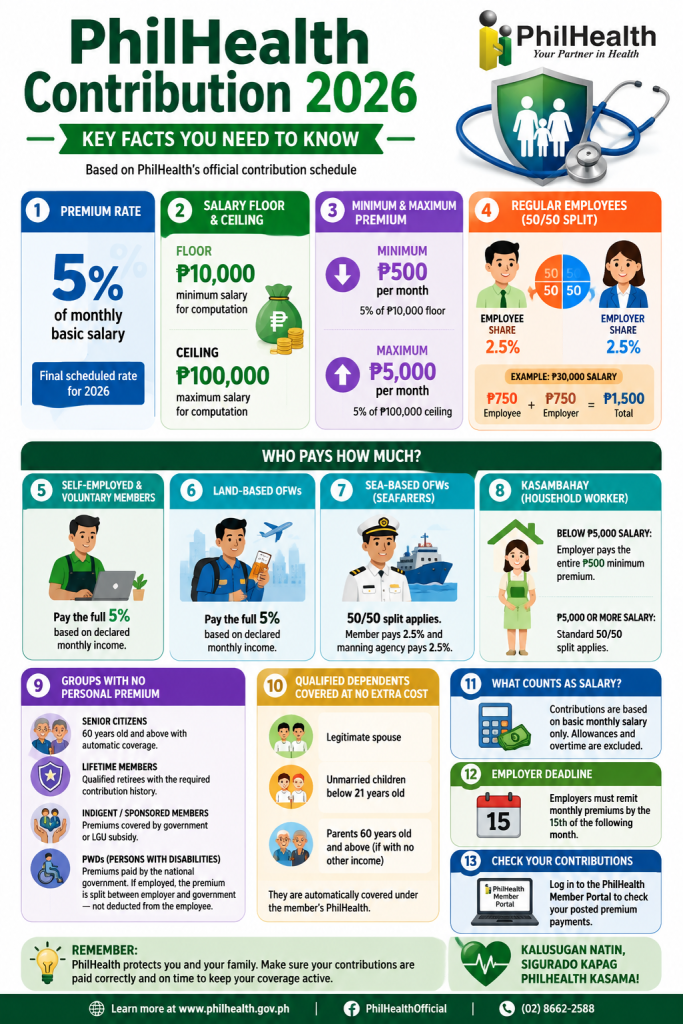
The PhilHealth premium rate is 5% of your monthly basic salary — and this is the final scheduled rate under the Universal Health Care Act (RA 11223). It’s been at 5% since 2024, held flat through 2025, and remains unchanged for 2026. There’s no new increase to watch for.
How the Rate Got Here
PhilHealth’s premium rate climbed gradually every year under the UHC Act’s schedule, reaching its final ceiling in 2024:
| Year | Premium Rate |
|---|---|
| 2019 | 2.75% |
| 2020 | 3.00% |
| 2021 | 3.50% |
| 2022 | 4.00% |
| 2023 | 4.50% |
| 2024–2026 | 5.00% (final rate) |
Salary Floor and Ceiling
Your premium is computed as 5% of your monthly basic salary, but only within a set range:
- Floor: ₱10,000 — if you earn less than this, your premium is still computed as if you earn ₱10,000 (minimum premium: ₱500/month)
- Ceiling: ₱100,000 — if you earn more than this, your premium caps at the ceiling amount (maximum premium: ₱5,000/month) — earning ₱150,000 doesn’t raise your deduction any further
How Much Employed Members Pay
The 5% is split equally:
- Employee share: 2.5%
- Employer share: 2.5%
Your employer deducts your 2.5% from your payslip and remits the full 5% to PhilHealth on your behalf. All employees — full-time, part-time, contractual, and probationary — must be enrolled by their employer.
Quick example: on a ₱30,000 basic monthly salary, you’d pay ₱750, and your employer contributes another ₱750 — ₱1,500 total.
How Much Self-Employed, Voluntary Members, and OFWs Pay
Without an employer to split the cost, you pay the full 5% yourself, based on your declared monthly income:
- Self-employed/voluntary members: declare your income using your latest Income Tax Return, or a notarized affidavit of income if you don’t have one yet. Same ₱10,000–₱100,000 floor and ceiling apply.
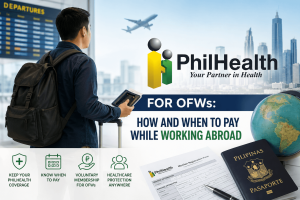
- Land-based OFWs: also pay the full 5% based on declared income, with flexible payment options — monthly, quarterly, semi-annually, or annually, whichever fits your work schedule abroad. Payments can be made through accredited collecting banks, GCash, PhilHealth’s ePHIC online portal, PhilHealth overseas representative offices, or select remittance agents.
- Sea-based OFWs (seafarers): genuinely different from land-based OFWs — seafarers follow the same 50/50 split as employed members, not the full-self-pay rule. Your share is deducted from your monthly salary, and your manning agency shoulders the employer’s share, remitting the combined 5% on your behalf.
Kasambahay (Household Worker) Contributions
Under the Kasambahay Law (RA 10361), the rule depends on your kasambahay’s salary:
- If your kasambahay earns below ₱5,000/month: you, as the household employer, pay the entire premium (₱500/month, computed off the ₱10,000 floor). Nothing gets deducted from their pay.
- If your kasambahay earns ₱5,000/month or more: the standard 50/50 split applies, same as any other employed member.
This applies to live-in or live-out house helpers, caregivers, nannies, gardeners, and family drivers formally registered as kasambahay. A family driver hired under a regular (non-kasambahay) employment contract follows the standard employer-employee split regardless of salary.
Who Doesn’t Pay Anything
Several groups are fully exempt from premiums, with coverage subsidized by government:
- Senior citizens (60 and above) — automatically covered for life under RA 10645, no premium required. Present a senior citizen ID or PhilHealth ID at any accredited facility.
- Lifetime Members — you qualify for permanent, premium-free coverage under any of these categories, per PhilHealth’s official criteria:
- Individuals aged 60 and above with at least 120 monthly contributions (the general rule)
- Uniformed personnel (AFP, PNP, BJMP, BFP) aged 56 and above with at least 120 monthly contributions
- SSS underground miner-retirees aged 50 and above with at least 120 monthly contributions
- SSS and GSIS pensioners prior to March 4, 1995
- Indigent/Sponsored Members — identified by DSWD as financially disadvantaged, covered through government or LGU subsidy.
- Persons with Disabilities (PWDs) — under RA 11228, all PWDs are automatically covered, with premiums paid by the national government. If you’re an employed PWD, you pay nothing personally — your premium is instead split between your employer and the national government, not deducted from your pay at all. This is confirmed directly by PhilHealth in response to an official public records request.
Dependents Covered at No Extra Cost
An employee’s legitimate spouse, unmarried children below 21 years old, and parents aged 60 and above (if they have no other income) are automatically covered as dependents under the member’s PhilHealth — no additional premium required for them.

When Payment Is Due
For employers, monthly premium remittance is due by the 15th of the following month. Missing this deadline exposes the employer to interest, surcharges, and potential legal action — and can leave employees without active PhilHealth coverage exactly when they need it most.
FAQs
Is there a new PhilHealth rate for 2026? No — 5% has been the rate since 2024, and it remains unchanged for 2026. This is the final scheduled rate under the UHC Act; PhilHealth has confirmed no new increase.
What if I earn exactly ₱10,000 or ₱100,000? At ₱10,000, your premium is the minimum ₱500/month. At ₱100,000, it’s the maximum ₱5,000/month. These are the exact floor and ceiling amounts, not just nearby thresholds.
Can my employer make me shoulder the full 5% instead of splitting it? No — for regular employed members, the 50/50 split is mandatory. Some employers voluntarily shoulder both shares as a benefit, but they cannot legally shift the full burden onto you.
How do self-employed members prove their declared income? Typically through your latest Income Tax Return, or a notarized affidavit of income if you don’t have one on file yet.
Are allowances and overtime included in the salary used for computation? No — PhilHealth contributions are computed on basic monthly salary only, excluding allowances and overtime pay.
Do seafarers pay PhilHealth the same way as other OFWs? No — this is a common mix-up. Sea-based OFWs (seafarers) actually follow the same 50/50 split as employed members, with their manning agency covering the employer’s share. Land-based OFWs, by contrast, pay the full 5% themselves.
Do PWDs need to pay PhilHealth premiums? No — under RA 11228, all PWDs are automatically covered with premiums paid by the national government. If employed, the premium is split between the employer and government, not the employee — meaning an employed PWD pays nothing out of pocket.
Where can I verify my posted PhilHealth contributions? Log in to the PhilHealth Member Portal, go to Premium Contributions, and check your posted payment history — there can be a delay of a few days to a few weeks between payment and when it appears.