SSS Contribution Table 2026: How Much Should You Pay
How much you should be contributing to SSS in 2026 — the 15% rate breakdown by membership type, MSC brackets, and links to the official contribution tables.
Rates below are confirmed directly against the official SSS Contribution Table page (sss.gov.ph), effective January 2025, and cross-checked across multiple independent sources. As of this writing (July 2026), SSS has not published a separate 2026 rate increase — the January 2025 schedule remains the current, applicable table.
Whether you’re an employee checking if your employer deducted the right amount, a self-employed member figuring out what to declare, or an OFW planning your monthly payment, here’s exactly how much you should be contributing to SSS in 2026.
The Short Answer
The total SSS contribution rate is 15% of your Monthly Salary Credit (MSC) — this is the final scheduled rate increase under the Social Security Act of 2018 (Republic Act 11199), and it’s been in effect since January 2025. There’s no new increase for 2026; the same rate and brackets carry over.

What Is Monthly Salary Credit (MSC)?
Your MSC isn’t your literal salary — it’s a bracket value SSS assigns based on your salary range, used specifically to compute your contribution and future benefits. The MSC ranges from a floor to a ceiling depending on your membership type:
- Regular members (employed, self-employed, voluntary): ₱5,000 minimum, ₱35,000 maximum
- OFW members: ₱8,000 minimum, ₱35,000 maximum
- Kasambahay (household workers): ₱1,000 minimum, ₱35,000 maximum
If your actual monthly income is above ₱35,000, your contribution still caps at the ₱35,000 MSC bracket — you don’t pay more even if you earn significantly more, though any salary credit above ₱20,000 MSC goes toward the mandatory Worker’s Investment and Savings Program (WISP), a separate provident fund on top of your regular SSS contribution.
How Much Do Employed Members Pay?
The 15% is split between you and your employer:
- Employer share: 10%
- Employee share: 5%
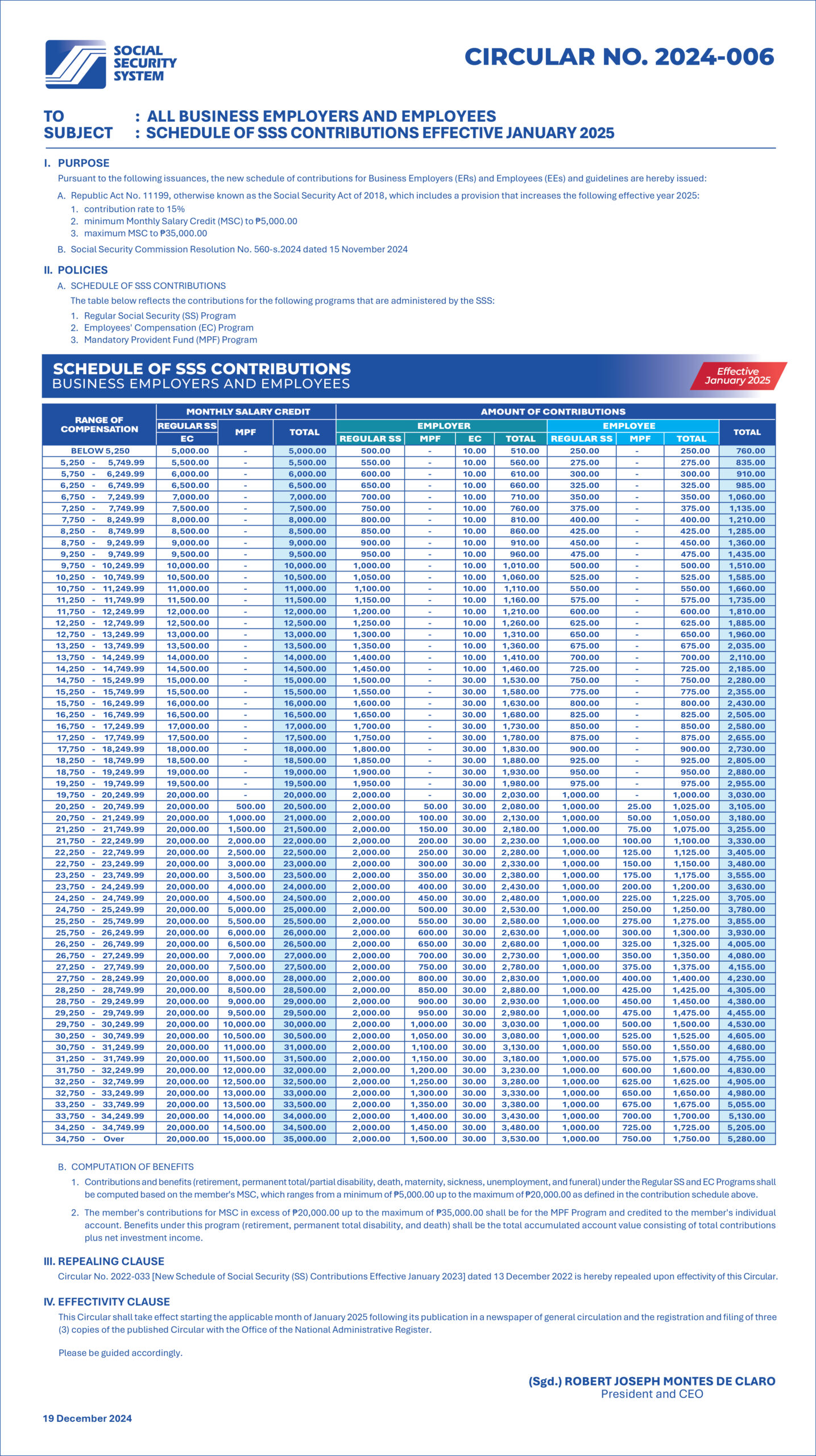
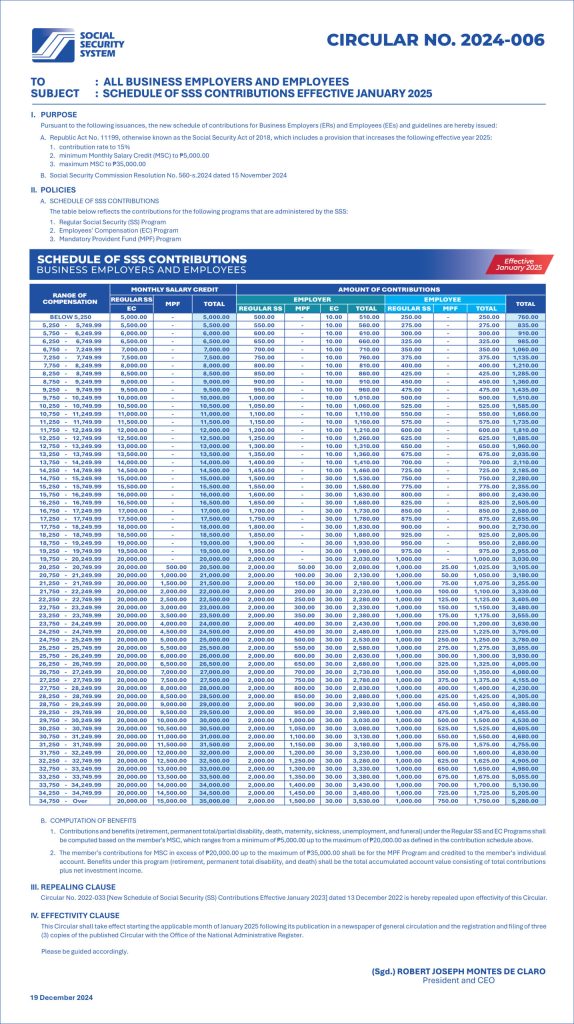
Your employer automatically deducts your 5% share from your payslip and remits the combined 15% to SSS — you don’t need to manually pay or compute this yourself. If you want to verify the exact peso amount for your specific salary bracket, check the official Employer-Employee contribution schedule (SSS Circular 2024-006) on the SSS Contribution Table page.
An Extra Employer-Only Contribution You Should Know About: EC
Separate from the 15% SSS contribution, employers also pay a small additional Employees’ Compensation (EC)contribution — this doesn’t come out of the employee’s pocket:
- ₱10/month for employees with MSC below ₱15,000
- ₱30/month for employees with MSC of ₱15,000 and above
Self-employed members pay their own EC contribution as part of their self-employed remittance. This is separate from, and on top of, the 15% regular SSS rate — worth knowing if you’re an employer double-checking your total remittance, or a self-employed member reconciling your payment.
How Much Do Self-Employed, Voluntary, and OFW Members Pay?
If you don’t have an employer to split the cost with, you shoulder the full 15% yourself, based on your declared or chosen MSC bracket:
- Self-employed members: declare income reflecting your actual or projected earnings; MSC ranges ₱5,000–₱35,000
- Voluntary members: can choose any MSC from ₱5,000–₱35,000 without needing to provide proof of income — though your chosen MSC directly affects your future benefit amounts (maternity, sickness, disability, pension), so choosing the minimum to save money now can mean smaller benefits later
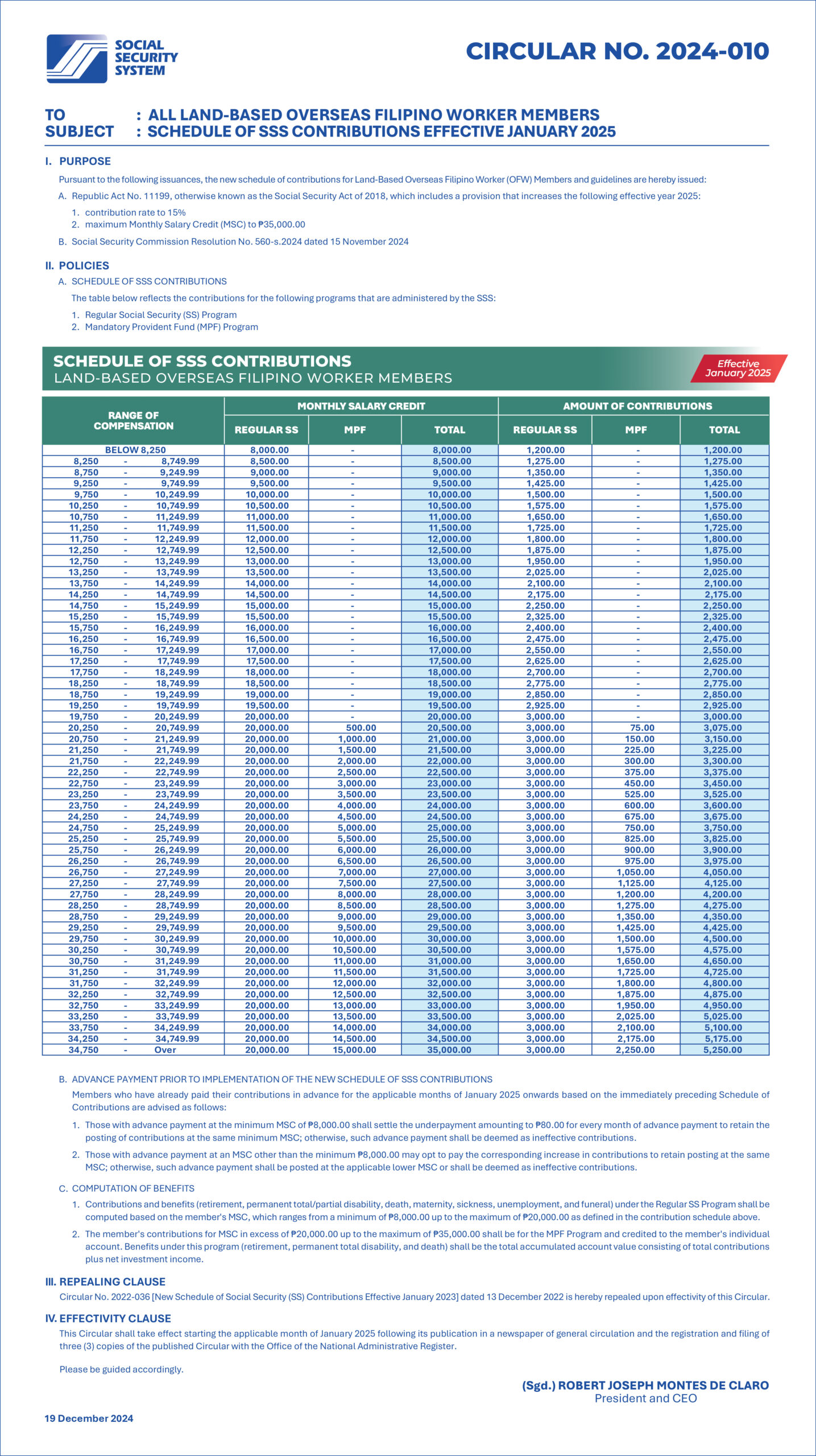
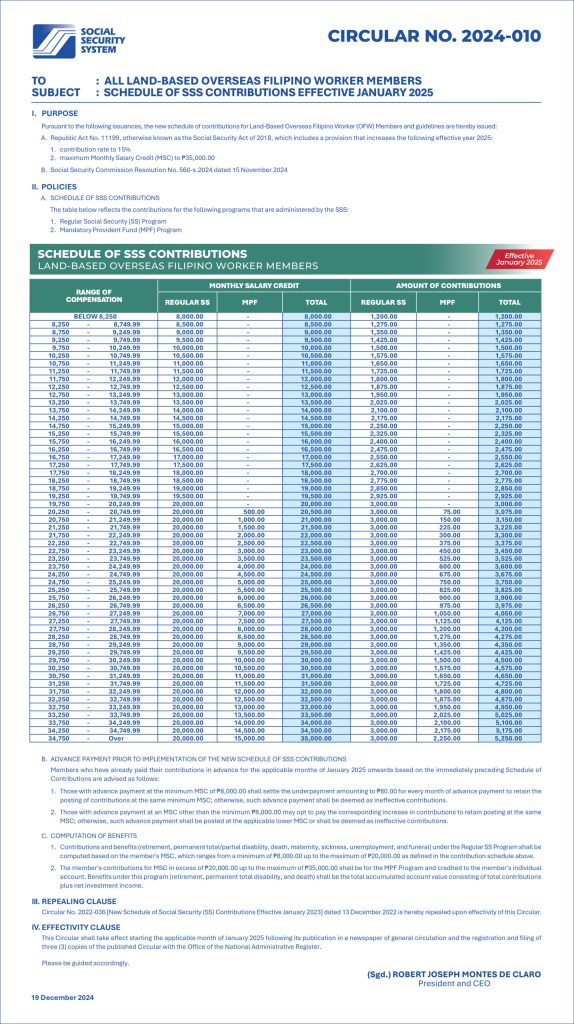
- OFW members: minimum MSC of ₱8,000 (higher than the regular ₱5,000 floor), maximum ₱35,000, same as other categories — this works out to a minimum monthly contribution of ₱1,200 and a maximum of ₱5,250
To qualify as a voluntary member, you must have at least one prior posted contribution as an employed, self-employed, or OFW member.
Kasambahay (Household Worker) Contributions
Kasambahay have their own contribution schedule, with a lower minimum MSC of ₱1,000 (versus the ₱5,000 floor for regular members):
- If the kasambahay’s monthly salary is below ₱5,000, the household employer shoulders the entire contribution — the kasambahay doesn’t pay anything out of pocket at this level.
- Once the salary reaches ₱5,000 or above, the contribution follows the same 10% employer / 5% employee split as regular employed members, and the household employer also pays the EC contribution on top.
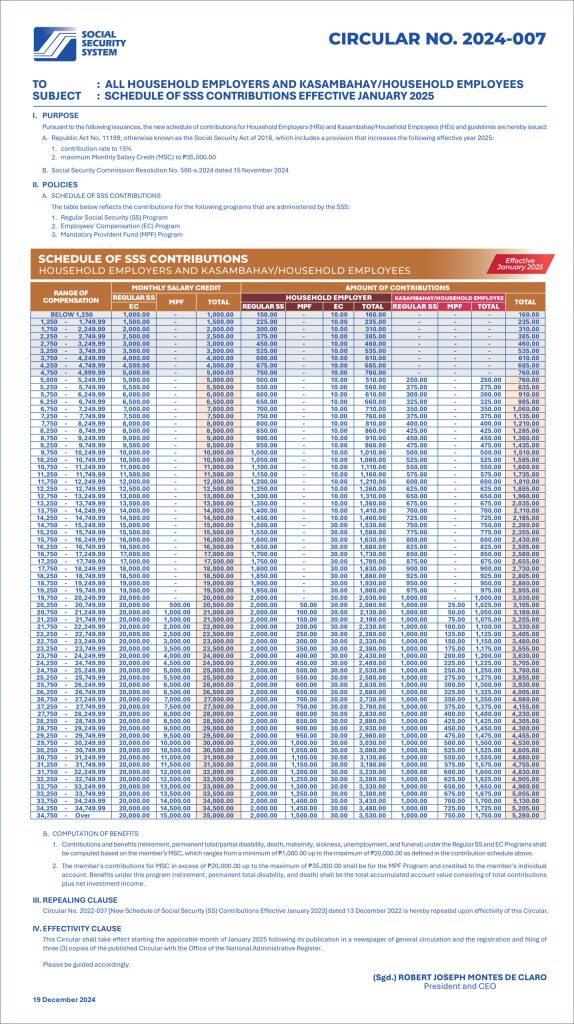
Household employers are required to register their kasambahay with SSS within 30 days of hiring and remit contributions monthly. Check the official Household Employer/Kasambahay circular (Cir. 2024-007) on the SSS Contribution Table page for the complete bracket-by-bracket breakdown.
Where to Find the Exact Peso Amount for Your Bracket
SSS publishes the complete, detailed contribution table as official circular images, broken down by membership type:
- Employer & Employee Table (Circular 2024-006)
- Household Employer & Kasambahay Table (Circular 2024-007)
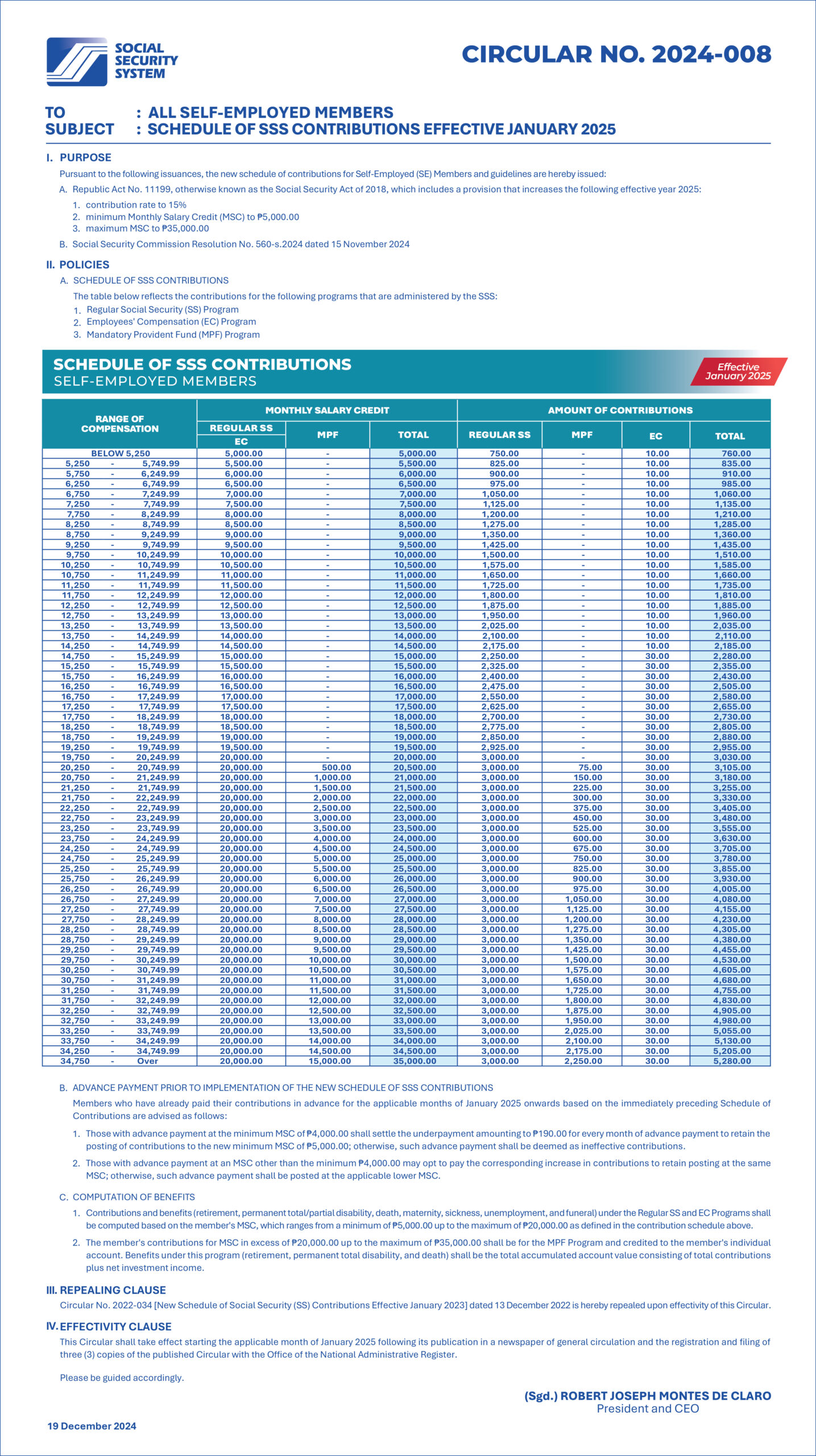
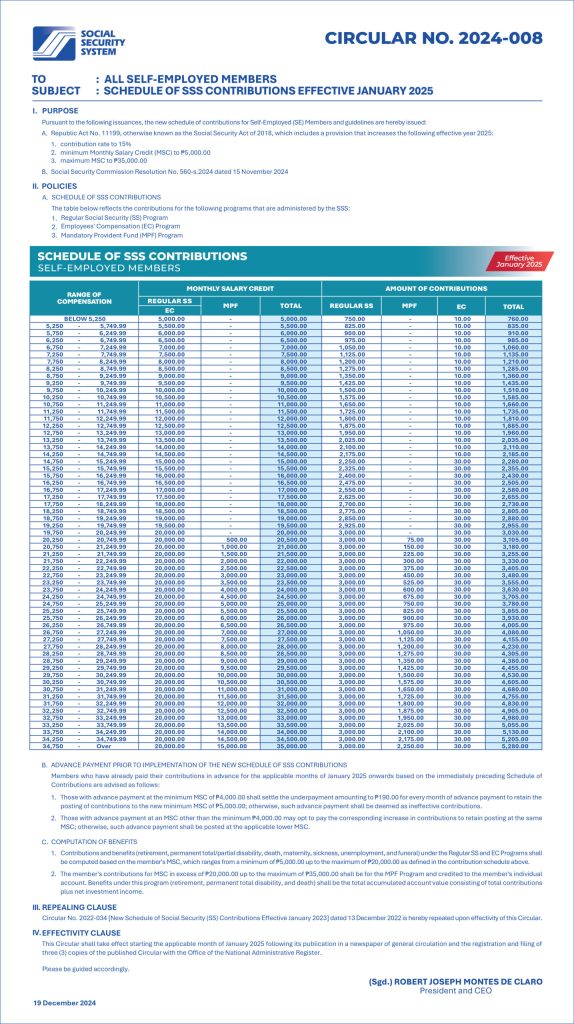
- Self-Employed Table (Circular 2024-008)
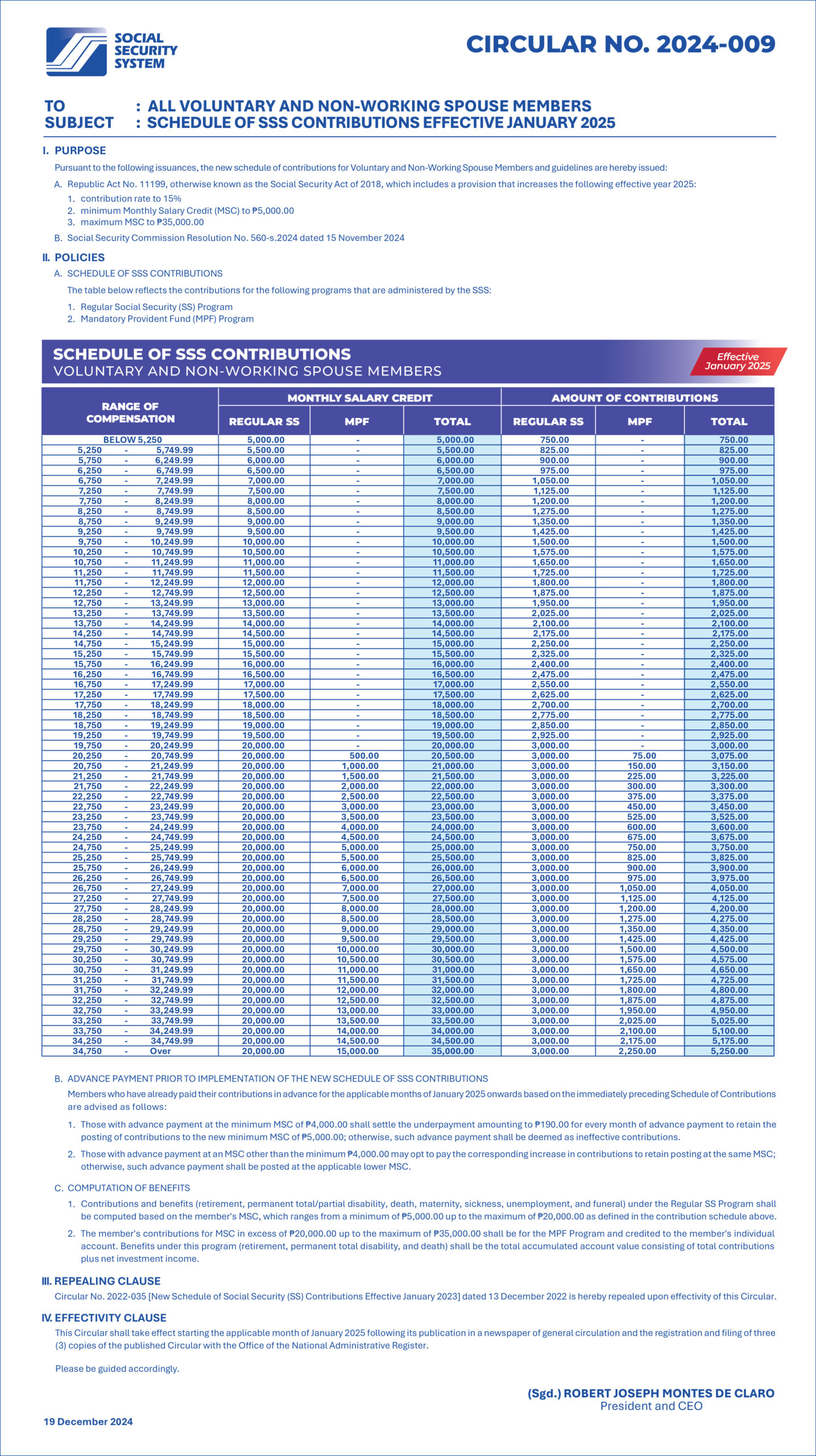
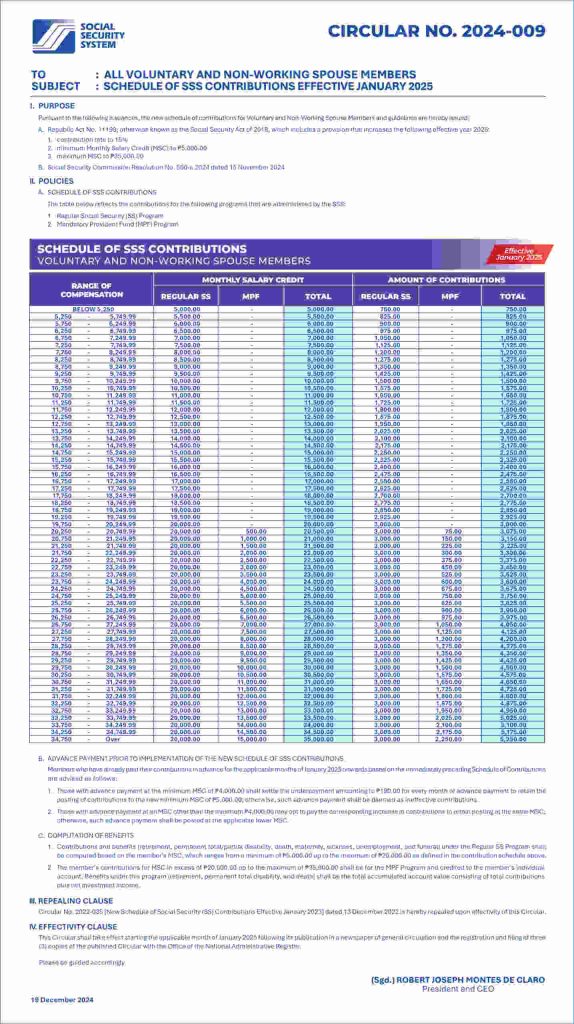
- Voluntary Member & Non-Working Spouse Table (Circular 2024-009)
- Land-Based OFW Table (Circular 2024-010)
See below the actual tables and circulars
Employer & Employee Table (Circular 2024-006)
Household Employer & Kasambahay Table (Circular 2024-007)
Self-Employed Table (Circular 2024-008)
Voluntary Member & Non–Working Spouse Table (Circular 2024-009)
Land-Based OFW Table (Circular 2024-010)
Quick Reference Summary
| Member Type | Total Rate | Employer Share | Employee/Member Share | Min MSC | Max MSC | EC (employer-paid) |
|---|---|---|---|---|---|---|
| Employed | 15% | 10% | 5% | ₱5,000 | ₱35,000 | ₱10 or ₱30 |
| Self-Employed | 15% | — | 15% (full) | ₱5,000 | ₱35,000 | ₱10 or ₱30 (self-paid) |
| Voluntary/NWS | 15% | — | 15% (full) | ₱5,000 | ₱35,000 | Not applicable |
| OFW (land-based) | 15% | — | 15% (full) | ₱8,000 | ₱35,000 | Not applicable |
| Kasambahay | 15% | Full cost if salary < ₱5,000; 10% above that | 0% if salary < ₱5,000; 5% above that | ₱1,000 | ₱35,000 | ₱10 or ₱30 (employer-paid) |
FAQs
Why did my SSS contribution go up recently? The 15% rate has been in effect since January 2025 as the final scheduled increase under RA 11199 — if you noticed an increase around that time, that’s the reason. There’s no additional increase specifically for 2026.
Is there a new SSS contribution table for 2026? No — as of this writing, SSS has not published a separate 2026 rate schedule. The January 2025 schedule remains the current, applicable table for 2026.
Should I choose the minimum or maximum MSC as a voluntary member? This is a genuine trade-off, not a simple answer: a lower MSC means a smaller contribution now but also smaller future benefits (maternity, sickness, disability, pension are all computed based on your MSC history). A higher MSC costs more monthly but builds a stronger benefit base. Consider your current budget against your long-term benefit goals.
What is WISP and do I need to worry about it? WISP (Worker’s Investment and Savings Program) is a mandatory provident fund that applies automatically once your MSC exceeds ₱20,000 — contributions on the portion above ₱20,000 go into WISP instead of the regular SS program, earning separate dividends. If your MSC is at or below ₱20,000, this doesn’t apply to you.
Is the EC contribution part of my 15%, or something extra? It’s extra — EC (Employees’ Compensation) is a small separate contribution (₱10 or ₱30/month depending on your MSC bracket) paid by your employer on top of the 15% SSS rate. As an employee, this doesn’t come out of your pay; if you’re self-employed, you pay your own EC as part of your remittance.
Do self-employed and voluntary members need to submit proof of income? No — you can choose your MSC bracket without providing income documentation, though it should reasonably reflect your actual earnings since it affects your future benefit computations.
Related guides: SSS Salary Loan: Complete 2026 Guide · How to Check Your SSS Contributions Online