SSS Maternity Benefits: Complete 2026 Guide
Everything about SSS Maternity Benefits — who qualifies, the official computation formula, maximum amounts, and how to apply, sourced directly from SSS.
This guide is sourced directly and entirely from the official SSS Maternity Benefit page (sss.gov.ph/maternity-benefit/), verified July 2026 — the most authoritative source available.
The SSS Maternity Benefit is a daily cash allowance paid to a qualified female SSS member who can’t work due to childbirth, miscarriage, or emergency termination of pregnancy (ETP). It’s granted regardless of civil status, employment status, legitimacy of the child, or how many times you’ve given birth before. Here’s everything you need to know — qualifying conditions, exact computation, how much you’ll receive, and how to apply.
Who Qualifies SSS Maternity Benefits
You’re qualified if you meet all of the following:
- At least 3 monthly contributions posted within the 12-month period immediately before the semester of your childbirth, miscarriage, or ETP. (Only contributions paid before the semester of contingency count — anything paid during or after doesn’t count toward this requirement.)
- If employed: you notified your employer of your pregnancy and expected delivery date, and the employer transmitted this notification to SSS.
- If self-employed, voluntary member, non-working spouse, or OFW: you notified SSS directly of your pregnancy and expected delivery date.
How Much You’ll Receive
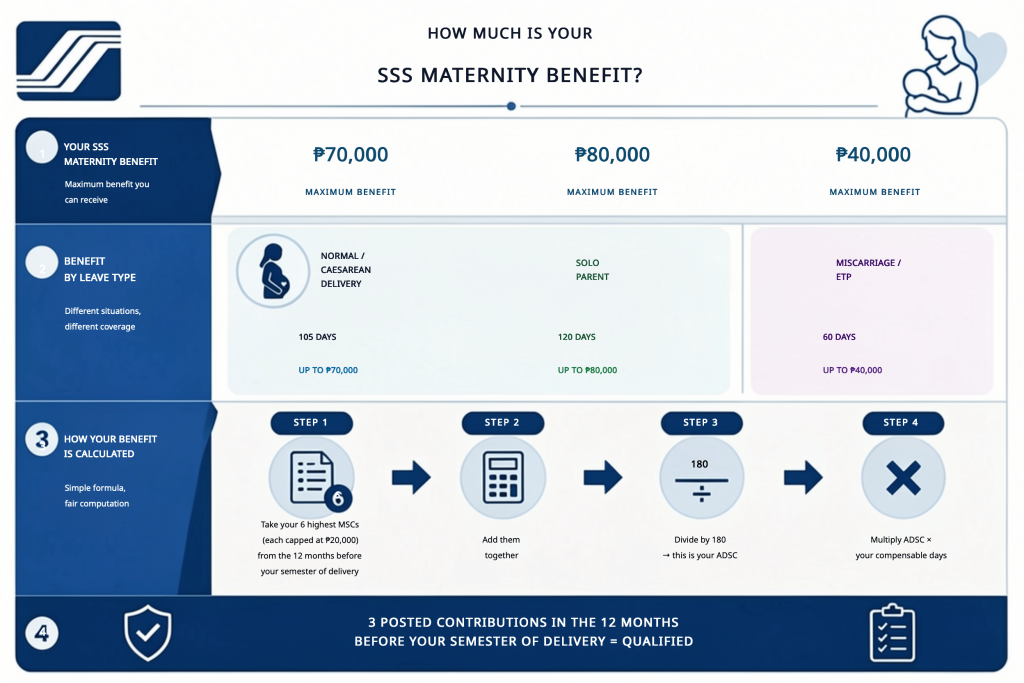
The benefit equals 100% of your Average Daily Salary Credit (ADSC) for a compensable period of:
| Days | Applies to |
|---|---|
| 105 days | Any live childbirth (normal or caesarean) |
| 120 days | Solo parents under RA 8972 (the extra 15 days is added on top of the 105) |
| 60 days | Miscarriage or ETP, including stillbirth |
How the Amount Is Computed (Official Formula)
- Exclude the semester of contingency. A “semester” is 2 consecutive quarters ending in the quarter of your childbirth/miscarriage/ETP. A “quarter” is 3 consecutive months ending in March, June, September, or December.
- Count 12 months backward, starting from the month immediately before that semester.
- Identify your 6 highest Monthly Salary Credits (MSC) within that 12-month period and add them together.
- Divide by 180 to get your Average Daily Salary Credit (ADSC).
- Multiply your ADSC by your compensable days (60, 105, or 120).
Important cap: per SSS Circular 2020-032, only contributions up to a ₱20,000 MSC count toward this computation — even though the overall Regular SS contribution schedule allows MSCs up to ₱35,000. This is the same ₱20,000 Regular SS cap that applies to the Salary Loan computation, not a separate rule specific to maternity.
Formula:
ADSC = (Sum of your 6 highest MSCs, each capped at ₱20,000) ÷ 180
Benefit = ADSC × compensable days
Maximum possible benefit at the ₱20,000 MSC cap:
- Normal/caesarean delivery (105 days): ₱70,000
- Solo parent (120 days): ₱80,000
- Miscarriage/ETP (60 days): ₱40,000
Your actual amount will be lower than these maximums if your posted MSCs during the qualifying period were below ₱20,000.
Who Pays What: Employed vs. Self-Employed/Voluntary/OFW
If you’re employed, you’re entitled to full pay during your maternity leave, made up of two parts:
- Your SSS maternity benefit (computed as above)
- A salary differential — the difference between your SSS benefit and your actual regular wage — paid by your employer
Employers are exempt from paying the salary differential (though they still must advance the SSS benefit and file for reimbursement) if they are:
- A distressed establishment
- A retail/service establishment with 10 or fewer workers
- A micro-business with total assets not exceeding ₱3 million
- Already providing benefits equal to or better than what RA 11210 requires
Employers seeking this exemption must file an Application for Exemption with DOLE within the first semester (first 6 months) of every calendar year — this is an annual submission, not a one-time approval, so employers must re-file and re-justify their exempt status each year.
If you’re self-employed, a voluntary member, non-working spouse, or OFW, you receive the SSS maternity benefit only — there’s no employer to provide a salary differential.
How and When You Get Paid
- Employed members: your employer advances your full pay within 30 days of your maternity leave application, then SSS reimburses the employer 100% of the SSS-computed portion.
- If you’re unemployed, temporarily laid off, your company is on strike/lockout, or you’ve separated from employment at the time of your contingency: SSS pays you directly instead of through an employer.
- Benefits are released to your (or your employer’s) enrolled disbursement account via DAEM — the same enrollment system used for SSS loans. You can enroll up to 3 disbursement accounts as an individual member.
Allocating Leave Days to the Child’s Father
For live childbirth only (not available for miscarriage/ETP), you can allocate up to 7 days of your maternity leave credits to:
- The child’s father (married or not), or
- A qualified alternate caregiver (a relative within the 4th degree of consanguinity, or your current partner sharing the same household)
This reduces your own leave credits by the number of days allocated. The father or caregiver must present a written notice from you stating the allocated days to their own employer.
A Few Important Rules to Know
- You can’t double-dip with sickness benefits — receiving a maternity benefit bars you from claiming a sickness benefit for the same period.
- Only one maternity benefit per delivery, regardless of how many babies you have (twins, triplets, etc. still count as one claim).
- Overlapping claims (e.g., two pregnancies close together) are still both paid, but consecutively — any overlapping period gets deducted from the current claim to avoid double payment.
- The leave can’t be deferred — it must be taken continuously, either before or after delivery, and postnatal care can never be less than 60 days.
- You have up to 10 years from the date of delivery, miscarriage, or ETP to file your claim — but don’t wait; filing promptly avoids complications with old records or documentation.
Employer Penalties and Employee Protection
Two important protections written directly into RA 11210, worth knowing whether you’re an employee or an employer:
- If your employer fails to remit your contributions or fails to properly notify SSS, and you miss out on your maternity benefit as a result, the law makes your employer directly liable — they must pay SSS damages equivalent to the benefit you would have received. In other words, an employer’s failure to comply doesn’t leave you without recourse.
- Non-compliant employers face real penalties: a fine of ₱20,000 to ₱200,000, imprisonment of 6 years and 1 day to 12 years, or both, at the court’s discretion.
How to Apply
Since September 1, 2021, maternity benefit applications are filed entirely online:
- If employed: submit your Maternity Notification Form to your employer along with proof of pregnancy (a signed pregnancy test result, or ultrasound/blood test results). Your employer then transmits the notification to SSS via their My.SSS account. You don’t need to submit proof of pregnancy to SSS directly — your employer isn’t required to forward it either.
- If self-employed, voluntary, non-working spouse, or OFW: notify SSS directly through your My.SSS account, the SSS Mobile App, or an SSS Self-Service Express Terminal.
- After delivery, the Maternity Benefit Application (MBA) or Maternity Benefit Reimbursement Application (MBRA) is filed online through the member’s or employer’s My.SSS account, with supporting documents (Certificate of Live Birth, medical certificates, or relevant documents depending on your specific case) uploaded as scanned copies.
FAQs
How many SSS contributions do I need to qualify? At least 3 monthly contributions within the 12-month period immediately before the semester of your delivery, miscarriage, or ETP.
Can self-employed or voluntary members claim maternity benefits? Yes — the same qualifying conditions apply, except you notify SSS directly instead of through an employer, and you receive the SSS benefit only (no employer-paid salary differential).
What’s the maximum SSS maternity benefit I can receive? ₱70,000 for a normal or caesarean delivery (105 days), ₱80,000 for a qualified solo parent (120 days), or ₱40,000 for a miscarriage or ETP (60 days) — based on the ₱20,000 MSC cap used in the computation.
Is the SSS maternity benefit the same as PhilHealth’s maternity coverage? No — these are two separate, independent benefits. PhilHealth’s maternity case rate helps cover hospital and delivery costs; the SSS maternity benefit is a cash allowance replacing your lost income during leave. Being an SSS member doesn’t reduce your PhilHealth benefit, and vice versa.
Can I still get the benefit if I already used up my previous pregnancies’ claims? Yes — there’s no limit on the number of pregnancies you can claim maternity benefits for.
What if my employer never remitted my contributions or never notified SSS about my pregnancy? You’re still protected — RA 11210 makes your employer directly liable for damages equivalent to the benefit you would have received if their non-compliance causes you to miss out. Document everything (payslips showing SSS deductions, any pregnancy notifications you gave your employer) and consider filing a complaint with DOLE or SSS if this happens to you.
What if my baby is stillborn? Stillbirth is treated the same as miscarriage/ETP for benefit purposes — 60 days of coverage, with the required supporting documents being a Certificate of Fetal Death rather than a Certificate of Live Birth.
Related guides: SSS Contribution Table 2026 · How to Check Your SSS Contributions Online