How to Choose a Digital Bank in the Philippines
Choosing a digital bank in the Philippines isn’t about chasing the highest advertised rate. Here’s what actually matters, including one BSP-licensed bank most comparisons forget.
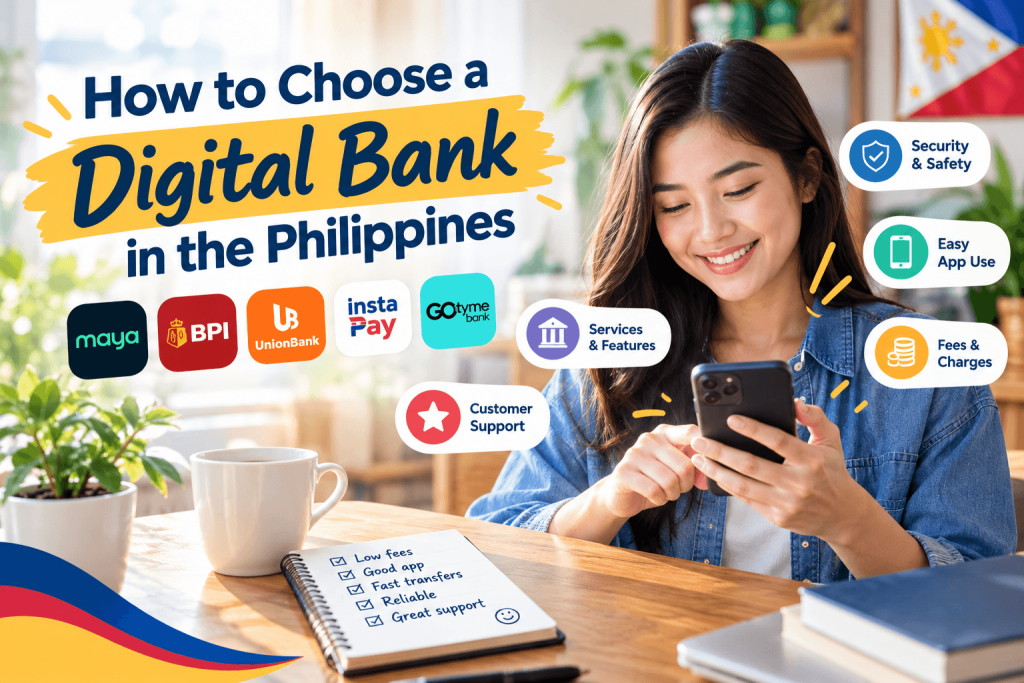
This guide focuses on how to compare digital banks properly and the traps that catch people, not a live rate table — interest rates at every bank listed here change monthly or more often, so always verify current rates directly with the bank before depositing. Sourced from PDIC’s official pages and multiple independent fintech comparison sites, verified September 2026.
There’s no single “best” digital bank in the Philippines — the right one depends on what you’re actually optimizing for, and the “highest interest rate” headline you see in an ad is usually not the number you’ll actually earn. Here’s how to evaluate your options properly.
The Trap Almost Every Comparison Falls Into: Headline Rate vs. Real Rate
Digital banks advertise two very different numbers, and ads lean hard on the bigger one:
- Base rate — what you actually earn on a normal balance with no special conditions.
- Promo or boosted rate — a much higher number, usually requiring a capped balance, a minimum monthly spend, an invite code, or a short promotional window.
Maya Bank’s “up to 15% per annum” is the clearest example, confirmed directly on Maya Bank’s own site: the real base savings rate is 3-3.5%, and the 15% boost only applies to a balance capped at ₱100,000, requires completing specific qualifying actions (an initial deposit plus using Maya for transactions), and even then only lasts for one calendar month before you’d need to requalify, it isn’t a rate you unlock once and keep indefinitely. If you only remember one thing from this guide, remember this: always check the base rate first, read exactly how long a boosted rate actually lasts, and treat the boosted number as something you might get temporarily, not something you’re guaranteed to keep.
The 20% Tax Nobody’s Headline Rate Mentions
Interest earned on Philippine bank deposits, digital or traditional, is subject to a 20% final withholding tax, deducted automatically before the interest is credited to your account. A bank advertising a 4% “gross” rate is really paying you roughly 3.2% after tax. When you compare rates across banks, make sure you’re comparing the same basis (gross vs. net) — some comparison sites quote gross, some quote the after-tax figure, and mixing the two makes a bank look better or worse than it actually is.
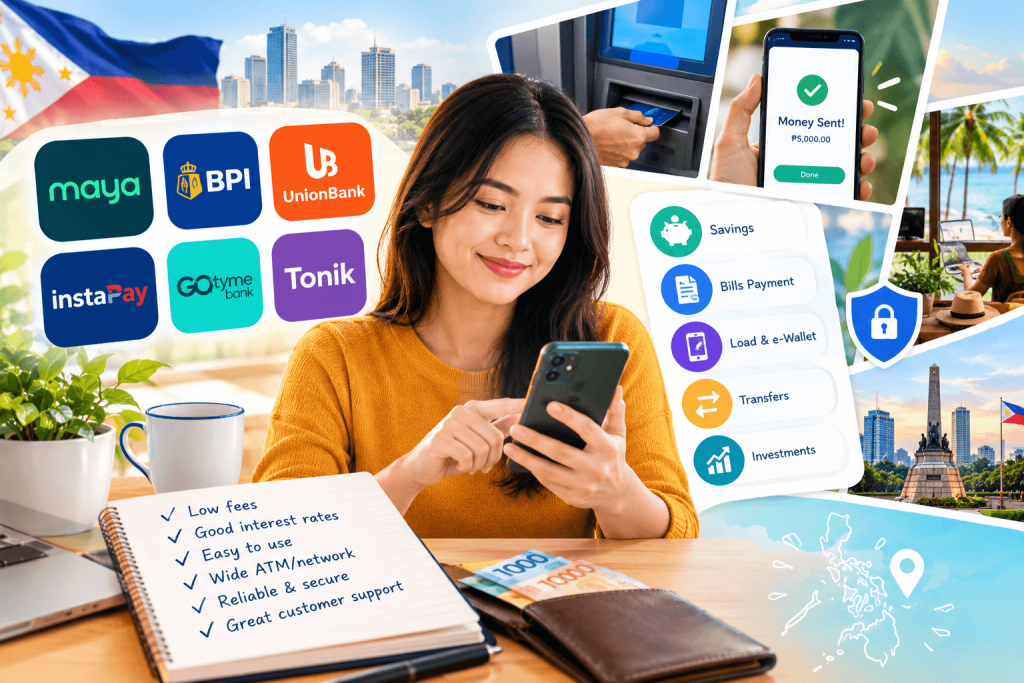
Don’t Put All Your Savings in One Digital Bank
This is the most overlooked practical advice in this whole topic. The Philippine Deposit Insurance Corporation (PDIC)insures deposits up to ₱1,000,000 per depositor, per bank — confirmed directly on PDIC’s own site, effective March 15, 2025 (doubled from the previous ₱500,000 cap). This means:
- If you keep more than ₱1,000,000 in a single digital bank and that bank fails, anything above the ₱1M cap is not guaranteed to be returned.
- The cap is per depositor, per bank, not per account — multiple accounts you hold at the same bank are added together and still capped at ₱1M combined.
- Joint accounts are insured separately from your individual accounts.
The practical takeaway: if your savings exceed ₱1 million, splitting deposits across two or three PDIC-insured digital banks protects more of your money than chasing the single highest rate at one bank — this is standard, sensible practice, not overly cautious.
What Else Actually Matters, Beyond the Rate
- Withdrawal and transfer fees — some digital banks offer free transfers to other banks via InstaPay/PESONet up to a certain limit per month, then charge afterward. Check this if you move money frequently.
- Minimum balance to earn interest — some banks require a minimum daily or end-of-day balance (even a small one) before any interest accrues at all.
- App reliability and customer support — digital banks have no physical branches, so if the app goes down or there’s an account issue, your only recourse is in-app support or a call center. Check recent app store reviews for red flags before committing significant savings.
- BSP license status — confirm the institution is one of the six actual BSP-licensed digital banks (Maya Bank, GoTyme, Tonik, UNO Digital Bank, UnionDigital, and Overseas Filipino Bank), not just an app offering a “savings” feature without full digital banking status.
GCash vs. Maya: You’re Actually Comparing Two Different Things
This mix-up is common enough to address directly: GCash is primarily an e-wallet, used for payments, transfers, and bills. Maya Bank is a separate, fully licensed digital bank (the banking arm behind the Maya app, formerly PayMaya) that offers actual interest-bearing savings accounts and PDIC insurance. If you’re comparing “GCash vs. Maya” specifically as a place to grow savings, you’re really comparing an e-wallet’s savings feature against a licensed bank’s product — worth knowing which one you’re actually evaluating before you decide based on convenience alone.
The Current Landscape, Briefly
As of this writing, the BSP has licensed exactly six digital banks in the Philippines: Maya Bank, GoTyme Bank, Tonik Digital Bank, UNO Digital Bank (UNObank), UnionDigital Bank, and Overseas Filipino Bank (OFBank). The BSP imposed a three-year moratorium on new licenses after these six, lifted it in January 2025, and opened four more slots (for up to 10 total) — three applicants had submitted by the November 2025 deadline, with a decision still pending as of this writing.
Worth knowing if you’re an OFW specifically: Overseas Filipino Bank is a subsidiary of Landbank, created specifically to serve OFWs and their families — worth a look alongside the five more general-purpose options, especially if you’re also reading our [OEC requirements] or [remittance] guides.
Each of the six licensed banks positions itself differently — some lean into high promotional rates with conditions (Maya), some keep it simple with no balance caps or spending requirements (GoTyme), and some focus on goal-based locked savings (Tonik’s Time Deposit products).
An important distinction worth knowing: not every app marketed as a “digital bank” actually holds a BSP digital banking license. A BSP official was quoted directly stating that institutions like CIMB Bank, Salmon Bank, MariBank, and OwnBank are “operating like digital banks but they have not really secured a digital bank license” — they’re existing commercial or rural banks offering digital-first savings products through an app, a different regulatory category from the six licensed digital banks above. This doesn’t necessarily make them less safe (many are still PDIC-insured banks in their own right), but if “being a licensed digital bank” specifically matters to you, confirm which category an institution actually falls into before assuming its marketing implies a BSP digital bank license.
Rather than listing specific rates here that will be outdated within weeks, check each bank’s own app or official rates page directly when you’re ready to decide, using the base-rate and PDIC-cap framework above to evaluate what you find.
FAQs
This changes monthly across the market, so there’s no fixed answer worth printing here — check each bank’s current official rates page, and apply the base-rate-vs-promo-rate distinction above to whatever you find.
Yes, as long as the institution is BSP-licensed and PDIC-insured, which all the major digital banks in the Philippines are — your deposit is protected the same way a traditional bank deposit is, up to the ₱1 million PDIC cap.
Yes — a 20% final withholding tax applies automatically, the same as with traditional bank deposits. The bank deducts this before crediting your interest.
Be cautious — promotional rates often come with withdrawal restrictions or balance caps that conflict with needing quick access to an emergency fund. A simpler, no-condition base rate account may serve an emergency fund better than a high promo rate with strings attached.
Yes, and for balances above ₱1 million, this is a genuinely sound strategy for maximizing your PDIC-insured coverage rather than concentrating risk in one institution.
Related guide: Best Ways to Send Money to the Philippines: What Actually Matters