SSS Death Benefit and Funeral Benefit: Complete 2026 Guide
The real SSS death benefit and funeral benefit amounts, who counts as a beneficiary, the pension formula, and how to file, sourced straight from SSS’s own pages.
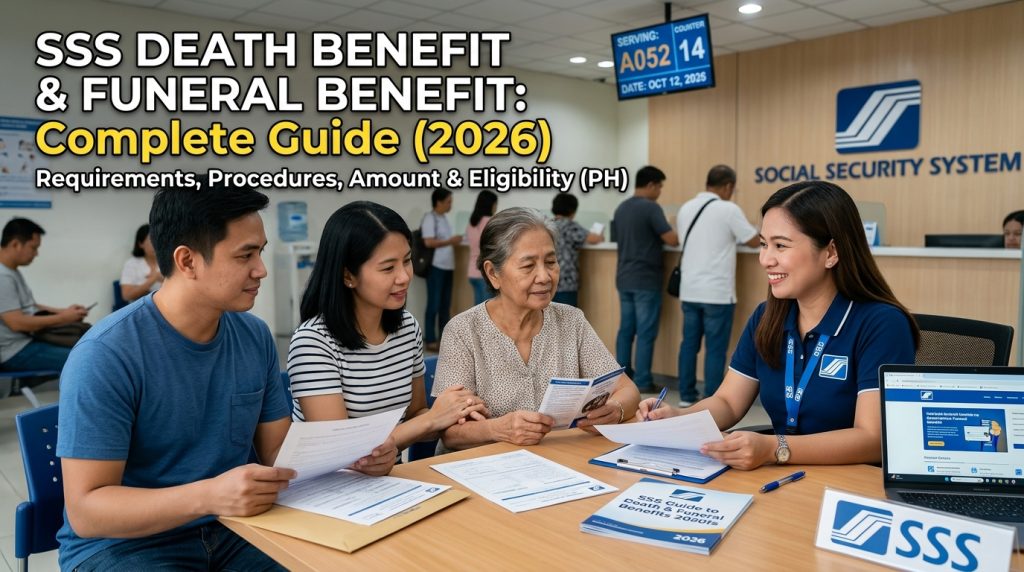
Sourced directly from the official SSS Death Benefit and Funeral Benefit pages (sss.gov.ph), verified September 2026.
When an SSS member or pensioner dies, SSS pays two separate benefits: a funeral benefit to whoever paid for the burial, and a death benefit, governed by Section 13 of the Social Security Act of 2018 (RA 11199), to the member’s qualified beneficiaries. These are commonly confused or treated as one thing. Here’s exactly how each one works, based on SSS’s own current pages, cross-checked against independent legal commentary.
The Two Benefits at a Glance
| Funeral Benefit | Death Benefit | |
|---|---|---|
| Purpose | Reimburses whoever paid for the burial | Financial support for the member’s dependents |
| Who receives it | Whoever defrayed the funeral cost — doesn’t have to be a relative | Primary beneficiaries (spouse, dependent children), or secondary (dependent parents) |
| Amount | ₱12,000 fixed, or ₱20,000–₱60,000 variable | Monthly pension for life, or a one-time lump sum |
| Applies to | Members, permanently totally disabled pensioners, or retirement pensioners | Members only |
You can claim both. They’re separate benefits filed separately, and receiving one doesn’t reduce or disqualify the other.
Funeral Benefit
How Much It Pays
Effective October 20, 2023, SSS’s official page sets the amount as:
- ₱12,000, fixed — if the member or pensioner had 1 to 35 posted contributions up to the month of death
- ₱20,000 to ₱60,000, variable — if they had 36 or more posted contributions up to the month of death
The variable amount is computed by SSS based on the deceased’s contribution history — it isn’t a number you calculate yourself. If you see an older guide quoting a flat ₱20,000 regardless of contributions, that’s outdated.
Who Can Claim It
Anyone who actually paid for the funeral expenses — this doesn’t have to be the surviving spouse or a blood relative. The member needs at least 1 posted contribution; permanently totally disabled pensioners and retirement pensioners qualify as well, not just active contributing members.
How to File
If you’re an SSS member yourself, you file online through My.SSS:
- Log in to My.SSS.
- Click Funeral Claim under the Benefits tab.
- Enter the deceased member’s SS Number/CRN, name, date of birth, date of death, and the amount of funeral expenses.
- Provide your civil status, your relationship to the deceased, and your preferred disbursement account.
- Upload your supporting documents (proof of the deceased’s SSS membership, death certificate, and proof of funeral expense payment if applicable) — images or PDF only, max 2MB each.
- Submit and check your email for confirmation.
If you’re not an SSS member, you file over the counter at any SSS branch instead — online filing is specifically for member-claimants.
One outdated requirement to be aware of: having a UMID card or an application for one used to be a prerequisite for online filing. SSS’s current page states this is no longer required — you just need an enrolled disbursement account through DAEM.
Documents You’ll Need
- Proof of the deceased’s SSS membership (UMID/SS card, old SSS records like E-1/E-4, employment records showing their SS number, or a prior SSS-issued letter with their SS number)
- Death certificate, PSA-registered or LCR-certified
- Original receipt for the funeral expenses, with BIR registration, in the claimant’s and deceased’s names
If you’re the surviving legal spouse and don’t have the original receipt, a marriage certificate plus an online certification that you paid the expenses can substitute.
If you’re not the spouse (a child, parent, or other party), you can submit proof of a pre-paid memorial/funeral plan instead of a receipt, or the receipt plus a notarized waiver from the surviving spouse.
Death Benefit
Monthly Pension or Lump Sum — Which Applies
- 36 or more posted contributions before the semester of death: primary beneficiaries get a lifetime monthly pension.
- Fewer than 36 contributions: primary beneficiaries get a one-time lump sum instead.
- No qualified primary beneficiaries exist: secondary beneficiaries (dependent parents) get a lump sum — they never receive the monthly pension, even if the member had 36+ contributions.
Who Qualifies as a Beneficiary
Primary beneficiaries, in order:
- The dependent spouse, until they remarry
- Dependent children (legitimate, legitimated, legally adopted, or illegitimate) who are unmarried, not gainfully employed, and under 21 — or older if permanently incapacitated since before turning 21
Secondary beneficiaries (only if no primary beneficiaries exist):
- The deceased’s dependent parents
If neither exists: any person the member formally designated in their SSS records, or failing that, their legal heirs under the Family Code’s rules of succession.
How Much the Monthly Pension Actually Is
Per SSS’s official formula, the monthly pension is the highest of:
- ₱300 + (20% × AMSC) + (2% × AMSC × (CYS − 10))
- 40% × AMSC
- A guaranteed minimum: ₱1,000 if under 10 Credited Years of Service (CYS), ₱1,200 at 10+ years, or ₱2,400 at 20+ years
(AMSC = Average Monthly Salary Credit; CYS = Credited Years of Service)
There’s no simple flat number here — SSS computes this based on the member’s actual contribution and salary history.
The Lump Sum, If Under 36 Contributions
- Primary beneficiaries get the higher of: (monthly pension × number of contributions paid), or (12 × monthly pension).
- Secondary beneficiaries get: 36 × monthly pension if the member had 36+ contributions, or the same “higher of” formula above if they had fewer.
Extra Benefits on Top of the Pension
- 13th month pension, paid every December, for primary beneficiaries receiving the monthly pension.
- An additional ₱1,000/month, on top of the pension, for all survivorship pensioners, effective since January 1, 2017.
- Dependent’s pension: 10% of the monthly pension, or ₱250, whichever is higher, per dependent child, up to 5 children, starting with the youngest.
A Genuine 2026 Update: The Pension Reform Program
On top of everything above, survivorship pensions (including the death benefit monthly pension) are currently getting an additional 5% increase per year, under SSS’s Pension Reform Program (Circular 2026-002). This is layered on top of the regular formula and the ₱1,000 additional benefit, not a replacement for either.
The increase is being rolled out in three scheduled tranches:
- Tranche 1: September 2025
- Tranche 2: originally scheduled for September 2026, but SSS moved it up and began rollout June 1, 2026 instead, citing inflation and rising costs
- Tranche 3: September 2027
By the end of this schedule, survivorship pensions will have increased roughly 15-16% cumulatively from their pre-2025 amount. (Retirement and disability pensions get a larger 10% annual increase under the same program, but that’s a different benefit from the death benefit covered here.)
If you’re already receiving a survivorship pension and it hasn’t reflected a recent increase, or you’re unsure whether your contingency date qualifies for the June 2026 rollout versus the later one, contact SSS directly or check your pension details through My.SSS — this program is actively rolling out as of this writing, not something to assume has already been applied automatically without checking.
What Can Reduce the Payout
Before you count on a specific number, know that SSS deducts certain things from the death benefit proceeds:
- Any unpaid short-term member loans (salary loans, etc.) — deducted in full
- Overlapping unemployment, sickness, or partial disability benefit amounts
- Overpaid pension amounts from a dependent’s death, employment, or marriage
How to File
Online filing is limited — per SSS Circular No. 2022-009, only the qualified dependent legal spouse, with an SS number registered in My.SSS, can file the death benefit claim online. Every other type of beneficiary (children, parents, designated beneficiaries, legal heirs) files over the counter at any SSS branch.
Documents You’ll Need
The full requirement list is extensive and depends heavily on who’s filing and whether records already match SSS’s system. At minimum, expect to provide:
- A Death Claim Application form
- The deceased’s PSA-registered or LCR-certified death certificate (or, if the member died abroad, a death certificate from the host country’s vital statistics office, or a Report of Death from the Philippine Embassy/Consulate)
- Valid ID with biometrics for the claimant
- Disbursement account details (UMID-ATM, or a PESONet-participating bank/e-wallet/remittance channel)
If you’re a primary beneficiary not already reflected in the deceased’s SSS records (or if there’s a discrepancy), you’ll also need a marriage certificate and/or the dependent children’s birth certificates. Secondary beneficiaries (parents) need the deceased’s birth certificate and proof that no primary beneficiary exists. Since the exact document list varies by situation, confirm with your SSS branch what applies to your specific case before filing.
FAQs
Yes — they’re separate benefits with separate requirements. Claiming one doesn’t affect your eligibility for the other.
No — the funeral benefit goes to whoever actually paid for the funeral expenses, which could be a friend, employer, or anyone else who covered the cost.
For the funeral benefit, they still qualify for the fixed ₱12,000 as long as they had at least 1 contribution. For the death benefit, primary beneficiaries get a lump sum instead of a monthly pension.
The formula itself (Formula 1, 2, and 3) is unchanged, but survivorship pensions are also getting an additional 5% yearly increase on top of that formula, under the Pension Reform Program (see the section above) — so your actual payout may be higher than the base formula alone suggests, depending on which tranche has been applied to your case.
SSS’s official pages for these two benefits don’t state a specific filing deadline in what we reviewed — but don’t delay, since gathering documents (especially death certificates and civil registry records) gets harder the longer you wait. Confirm directly with SSS if you’re filing long after the death occurred.
The benefit goes to whoever the member formally designated in their SSS records. If no one was designated, it passes to the legal heirs under the Family Code’s succession rules.
No — SSS’s current guidance states a UMID card (or an application for one) is no longer a prerequisite for filing the funeral benefit online. You just need a registered My.SSS account and an enrolled disbursement account.
Related guides: SSS Contribution Table 2026 · SSS Salary Loan: Complete 2026 Guide · CSF PhilHealth: Claim Signature Form, CF1, and CF2 Explained