PhilHealth Claim Forms Explained: CSF, CF1, and CF2 (Plus Reimbursement)
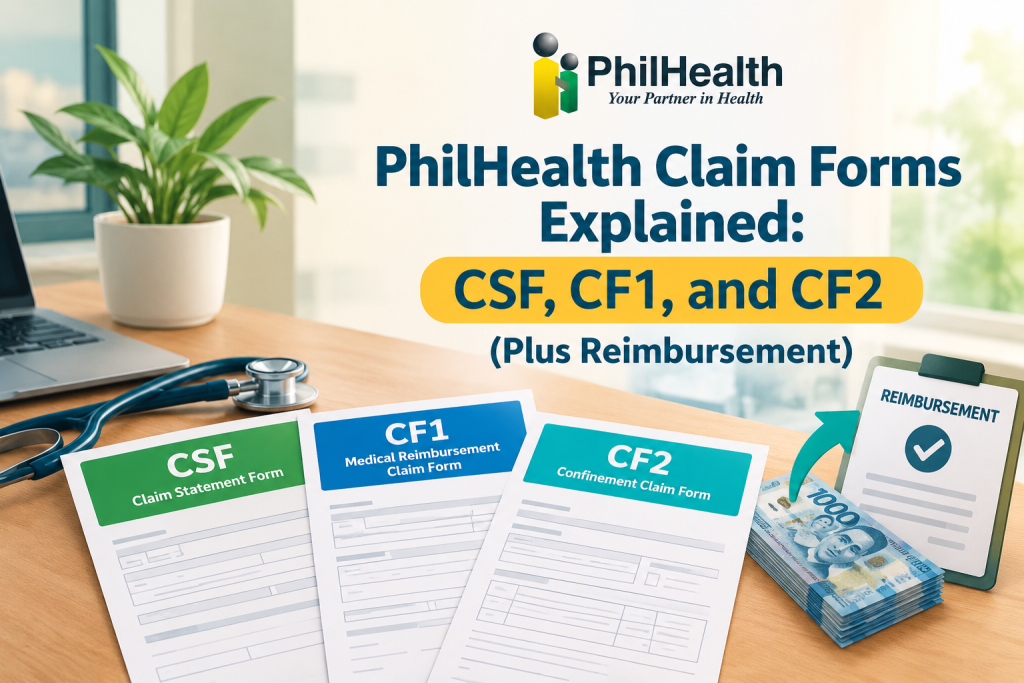
Based on PhilHealth’s own circulars and advisories (including Circular 2022-0013 on immediate eligibility and Advisory 2018-0031 on the CSF), its official Claim Form 1 (September 2018 revision) and claim-form guidelines, and cross-checked against independent 2026 guides, verified September 2026.
If a hospital has handed you a stack of PhilHealth forms, or you’re trying to work out whether you need to file anything yourself, here’s the short version: most of these forms are completed by the hospital, not you. Your job is mainly to provide your documents, sign where needed, and know the few situations where you do have to file on your own.
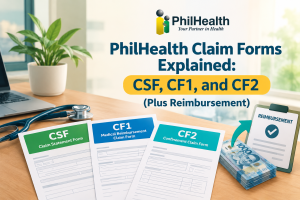
The Forms at a Glance
| Form | What it is | Who completes it |
|---|---|---|
| CF1 (Claim Form 1) | Member and patient information, plus an employer certification for employed members | You (the member), with your employer if you’re employed |
| CF2 (Claim Form 2) | The health care provider’s certification: diagnosis, services, charges, and the PhilHealth deduction | The hospital and attending doctors, not you |
| CSF (Claim Signature Form) | One form that gathers the signature portions of CF1 and CF2 | Signed by the member, the patient (or a representative), the employer if applicable, and the hospital and doctors |
| CF3 (Claim Form 3) | The patient’s clinical record | The hospital or provider, and only for certain cases |
| PMRF | Registration or update form | You, or a representative, if the patient isn’t yet registered |
Important: You Don’t Fill Out CF2 Yourself
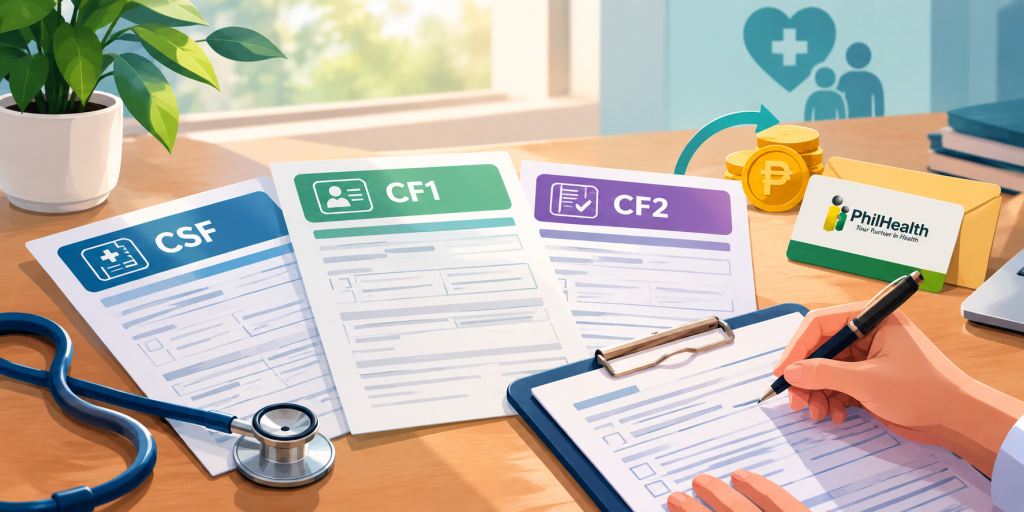
If you searched for a “CF2 form” expecting to fill one out, this is the part worth knowing. CF2 is the health care provider’s certification. PhilHealth’s own guidelines describe it as containing the hospital’s information, the patient’s diagnosis, a summary of services with the corresponding charges, and the amount of PhilHealth benefit deducted. The attending doctors complete and sign their own portions.
PhilHealth’s guidelines also state that CF1 and CF2 are both required for all claims except confinement abroad. For hospital confinements in the Philippines, you should never be the one compiling CF2.
Why it still matters to you: an unsigned or incomplete CF2 is one of the most commonly reported reasons claims get returned. If you’re going to file a reimbursement yourself, make sure the doctors have signed before you leave the hospital, since chasing signatures afterward is much harder.
If the patient died during the confinement, the form has a specific box for the date of death, so the hospital simply records it there.
CF1: The Member’s Form
CF1 has two parts:
- Part I (member and patient information): your PhilHealth Identification Number (PIN), membership category, name, mailing address, date of birth, contact details, and whether the patient is you or a dependent. The member signs to certify the information is correct.
- Part II (employer’s certification, for employed members only): your employer certifies your premium contributions.
Names must match your MDR. If the name you write differs from what’s on your Member Data Record, PhilHealth’s guidelines tell you to attach supporting documents such as a birth or marriage certificate so the record can be updated. See our [PhilHealth MDR guide] and [PMRF guide] for how to fix a mismatch.
Someone else can sign for you if you can’t. The guidelines allow an authorized representative (a child 18 or older, spouse, parent, or guardian/next of kin) to sign on the member’s behalf when the member is abroad or out of town, incapacitated, or for another stated reason.
The latest official CF1 we found on PhilHealth’s site is the September 2018 revision: philhealth.gov.ph/downloads/claim/ClaimForm1_092018.pdf. PhilHealth’s claim forms are marked as not for sale, so never pay anyone for a blank copy.
CSF: The Claim Signature Form
The CSF is more than a simple signature page. PhilHealth’s own circular describes it as containing the portions of Claim Forms 1 and 2 that require signatures: the hospital, the member, the patient, and the employer where applicable. The version circulating online includes:
- Member and patient details and the confinement period
- The member’s certification, and the employer’s certification if the member is employed
- Consent for PhilHealth to examine the patient’s medical records to verify the claim
- Certifications from the healthcare professionals and the healthcare institution
- A section for someone signing on the patient’s or member’s behalf, with the reason (for example, the patient is incapacitated)
Why hospitals insist on it: under PhilHealth’s electronic claims system, the CSF is one of the mandatory scanned attachments for every claim, and PhilHealth Advisory 2018-0031 requires accredited hospitals to use the updated version. You can view PhilHealth’s official copy at philhealth.gov.ph/downloads/claim/ClaimSignatureForm.pdf.
In practice, the hospital’s PhilHealth desk hands it to you and tells you where to sign. The most common mistake is a missing or misplaced signature, which can send the whole claim back, so check every signature line before you leave.
CF3: Only for Certain Cases
CF3 is the patient’s clinical record, completed by the provider to support CF2. Per PhilHealth’s guidelines it’s required for Level 1 facilities, case type D claims, the Maternity Care Package, emergency or transferred cases, and confinements under 24 hours. You’ll rarely deal with it directly, but if you’re asked about it, this is why.
Direct Filing vs. Reimbursement: Do You Have to File Anything Yourself?
Usually, no. At a PhilHealth-accredited hospital, the hospital files your claim electronically and the PhilHealth benefit is deducted from your bill at discharge. You give your details, sign the forms, and settle only the balance.
Members filing for reimbursement themselves is the exception. PhilHealth circulars we found restrict direct filing by members mainly to:
- Confinement abroad
- Emergency confinement in a non-accredited facility, where transferring to an accredited hospital wasn’t possible or feasible
Independent 2026 guides describe the same situations. A routine, non-emergency stay at a non-accredited hospital generally isn’t reimbursable, so confirm with your PhilHealth office before paying a non-accredited hospital in full and expecting to recover it.
If your accredited hospital failed to file or the benefit wasn’t applied: PhilHealth’s immediate-eligibility circular (2022-0013) allows registered members who couldn’t avail of benefits to file directly through a letter of appeal together with the claim documents and a hospital waiver, subject to PhilHealth’s appeal policies. Ask the hospital’s PhilHealth desk first, since they normally control the filing.
The Deadline: Don’t Miss It
PhilHealth’s own Claim Form 1 states that for local availment, claim documents must be filed within 60 days from the date of discharge, and for benefits availed abroad, within 180 days from discharge. Independent guides consistently warn that missing the window generally means forfeiting the claim, so treat 60 days as a hard limit.
You may have read that PhilHealth gave flexibility on late-filed claims. Circulars 2025-0006 and 2025-0019 let health facilities re-file claims that had been denied solely for late submission, covering claims filed from January 1, 2018 to December 31, 2024, within limited re-filing windows. That relief is for hospitals re-filing old denials, not for members, and it doesn’t change the 60-day deadline for new claims.
What to Bring
Independent guides consistently list:
- Completed CF1 and the CSF
- CF2, signed by the attending doctors
- Original official receipts
- An itemized Statement of Account from the hospital
- Medical abstract or discharge summary
- A valid ID
- Your MDR, if you have it
Where to File and How Long It Takes
Submit the complete packet to any PhilHealth Local Health Insurance Office (LHIO) or Regional Office. Some guides also mention an upload option through the Member Portal; check with your LHIO before relying on it.
Processing time varies widely by source, from roughly 30 working days to as much as 120 days. The law’s stated target for reimbursement is 60 days, but delays for incomplete documents are common, so ask your LHIO for their current estimate and keep your claim reference number.
Common Reasons Claims Get Rejected
- Missing signatures on CF1, CF2, or the CSF
- Filing after the deadline
- An attending physician who isn’t PhilHealth-accredited
- Not being found as a registered member in PhilHealth’s system
- Some guides also list lapsed contributions, though PhilHealth’s own circular says unpaid premiums shouldn’t block benefits (see below)
If your claim is rejected, one guide reports an appeal window of 60 days from the rejection notice; confirm the exact deadline printed on your own notice.
Are You Even Eligible? The Old “3 in 6 Months” Rule Is Gone
Many guides still repeat that you need 3 monthly contributions in the 6 months before admission. PhilHealth’s own Circular 2022-0013 says otherwise: it replaced that qualifying-contributions requirement with immediate eligibility, repealing the earlier circular that required it. Under it:
- Registered Filipinos and their qualified dependents get benefits regardless of the number of contributions paid, at accredited and contracted health facilities in the Philippines.
- Failure to pay premiums doesn’t prevent you from enjoying benefits. You still owe missed contributions, with interest (at least 3% for employers, up to 1.5% for self-earning members and migrant workers, compounded monthly), but that’s collected separately from your claim.
- Hospitals check your status through a PhilHealth online portal. A “YES” means you’re entitled to benefits, and hospitals should no longer require proof of contributions. A “NO” means you need to register or apply for a PIN during the confinement to become eligible.
- You don’t need to show your PhilHealth ID card, but you still need a valid ID to prove your identity.
Two cautions: the circular states it does not cover services from health facilities outside the Philippines, so confinement abroad may still be assessed differently (see our [PhilHealth OFW payment guide]), and some third-party guides report that hospitals still ask about contributions in practice. If a hospital declines to deduct your benefit citing contributions, ask them to verify your status on PhilHealth’s eligibility portal, and call the PhilHealth Action Center at (02) 8441-7442.
Also remember that PhilHealth pays fixed case rates, so if the rate doesn’t cover the full bill, you shoulder the difference.
Is There a “PhilHealth Death Claim”?
Not as a cash payout to the family, based on what we could confirm. In the PhilHealth circulars we reviewed, we found no standalone death benefit for regular members, and independent commentary agrees that PhilHealth provides health benefits rather than life insurance. If a member or dependent is hospitalized and then dies, PhilHealth may still cover the confinement, but that’s the ordinary hospital benefit, claimed the ordinary way.
What PhilHealth’s circular does protect for grieving families:
- A Filipino who wasn’t yet registered but dies during confinement in an accredited or contracted facility is still entitled to program benefits.
- The next of kin, a social worker, or authorized hospital personnel may fill out the PMRF on behalf of the deceased or incapacitated patient, with the hospital stating the reason.
In plain terms: if a family member died in hospital, ask the hospital’s PhilHealth desk to file the claim. Don’t assume coverage was lost because the patient was unregistered or behind on premiums.
A conflicting claim worth flagging: at least one law-commentary website states that PhilHealth pays up to ₱100,000 for inpatient death cases plus ₱20,000 burial assistance. We couldn’t find this in any PhilHealth document, and it contradicts the other sources we checked. Treat it with caution and confirm directly with PhilHealth before counting on it.
One real, narrow exception, now closed: PhilHealth Circular 2021-0007 created a COVID-19 vaccine injury compensation package with a ₱100,000 lump sum, paid once per beneficiary, for permanent disability or death from serious adverse effects of vaccines under the Philippine vaccination program. According to reports of the circular, it covered claims filed from March 3, 2021 until March 2, 2026, or until the vaccination program ended, whichever came first, so it appears to be closed to new claims. It was never a general death benefit.
If you’re looking for actual death and funeral benefits, those come from other agencies. SSS, for example, pays a death benefit to a member’s beneficiaries, as a monthly pension if the member paid at least 36 monthly contributions before the semester of death, or a lump sum if fewer. See SSS’s official page at sss.gov.ph/death-benefit.
FAQs
No. The hospital and attending doctors complete it. For reimbursements, you’re responsible for making sure it’s signed before you leave the hospital.
Your hospital’s PhilHealth desk will provide them, and PhilHealth’s official website has a downloads section. PhilHealth’s own guidelines document, which explains CF1, CF2, and CF3 field by field, is at philhealth.gov.ph/downloads/claim/PhilHealth_ClaimForm_Guidelines.pdf. Forms are not for sale, so don’t pay for a blank copy.
Under PhilHealth’s immediate-eligibility circular, hospitals should rely on the eligibility portal and no longer require proof of contributions when it returns “YES.” If a hospital insists, see the cautions in the eligibility section above.
Yes. An authorized representative (a child 18 or older, spouse, parent, or guardian/next of kin) can sign on your behalf, with the reason indicated on the form.
Ask the PhilHealth desk to explain why and to check your status on PhilHealth’s eligibility portal. Common causes include not being found as a registered member, an unregistered dependent, or a name mismatch with your MDR. See our guides on [PhilHealth MDR] and [contributions not posting].
No. PhilHealth’s guidelines state CF1 and CF2 are required for all claims except confinement abroad, where CF1 and supporting documents are filed within 180 days.
Related guides: PhilHealth MDR: What It Actually Is, and How to Get Yours · PhilHealth Updating Form (PMRF) · PhilHealth OFW Payment: How and When to Pay While Working Abroad · PhilHealth Contribution Delayed or Not Posting?