BIR Form 1901 vs 1902 vs 1903: Which Registration Form Do You Actually Need?
Which BIR form do you actually need — 1901, 1902, or 1903? A clear breakdown by taxpayer type, plus a genuine RDO ambiguity most guides get wrong.
Sourced from Grant Thornton Philippines’ professional tax commentary, Wise, and official BIR form documentation, verified July 2026.
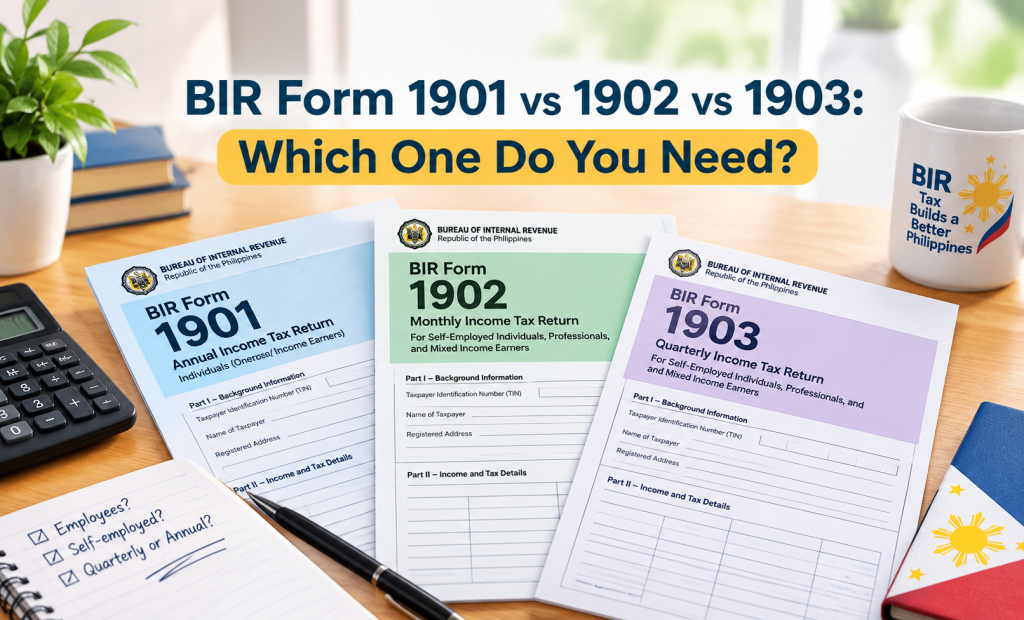
Picking the wrong BIR registration form is one of the most common reasons applications get bounced — and the forms look confusingly similar at a glance. Here’s the clear breakdown of which one applies to you.
Quick Answer
| Your situation | Form you need |
|---|---|
| Employee earning only a salary | 1902 |
| Freelancer, self-employed, professional, or sole proprietor | 1901 |
| Employed and earning freelance/business income on the side (mixed income) | 1901 |
| Corporation, partnership, cooperative, or government agency | 1903 |
| One-time transaction or first-time job seeker under E.O. 98 | 1904 |
BIR Form 1902: For Employees
Official title: Application for Registration for Individuals Earning Purely Compensation Income (Local and Alien Employee)
Who files it: first-time employees with no existing TIN, resident alien employees working for a Philippine company, and special non-resident aliens on temporary work assignment.
Key details:
- Deadline: within 10 days from your date of employment. Securing a new employee’s TIN within this window is legally the employer’s responsibility, not yours — though if your employer hasn’t done it, you can submit Form 1902 yourself at your assigned RDO.
- There’s no registration fee for employees filing Form 1902.
- Employers now secure new employees’ TINs through ORUS’s Employer Services Link (added under RMC No. 10-2024) rather than the older eRegistration (eReg) system, which has been superseded. Manual Form 1902 submission at the RDO remains the fallback where online processing isn’t available.
- If you have multiple concurrent employers, you register through your principal (main) employer.
What happens after: your TIN is assigned permanently for life, your employer uses it to withhold tax from your salary, and at year-end you receive BIR Form 2316 summarizing your salary and tax withheld. If you had one employer all year and tax was withheld correctly, you qualify for substituted filing — meaning your employer files on your behalf and you don’t file separately.
A Related Nuance Worth Knowing: RDO Rules for Job-Changers
For initial Form 1902 registration, this part is clear and well-confirmed: your RDO is based on your employer’s address, not your residence — this is the standard, current rule, confirmed as recently as this year.
Where it gets genuinely murkier is a narrower, specific scenario: employees who already have a TIN and then change employers. Grant Thornton, a major professional accounting firm, flagged that BIR’s RMO No. 37-2019 introduced a provision suggesting that job-changers’ registration records should transfer to the RDO covering their residence, rather than automatically following them to their new employer’s RDO — a shift from the prior practice. Grant Thornton also noted the RMO itself doesn’t clarify whether “residence” means permanent or current address. This flag dates to 2019, and we couldn’t confirm whether the ambiguity has since been fully resolved in practice.
The practical takeaway if you’re changing jobs: don’t assume — Form 1905 handles the RDO transfer either way (covered in our Form 1905 guide), so confirm with your new employer’s HR or BIR directly which RDO you’ll actually be assigned to, rather than guessing based on the general “employer’s RDO” rule that applies cleanly to first-time registration.
BIR Form 1901: For Self-Employed, Freelancers, and Mixed Income
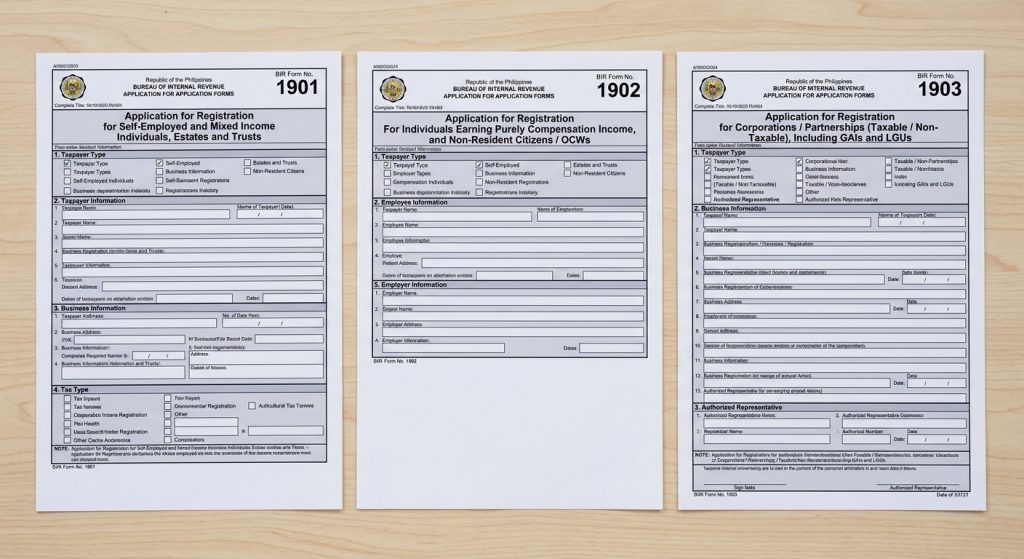
Official title: Application for Registration for Self-Employed (Single Proprietor/Professional), Mixed Income Individuals, Estates and Trusts
Who files it:
- Self-employed individuals and sole proprietors
- Licensed professionals practicing independently
- Mixed-income earners — if you’re employed and freelancing on the side, this is your form
- Non-resident aliens engaged in trade or business in the Philippines
- Estates and trusts
Key details:
- File before you start earning from any business or professional activity. Registering after you’ve already begun operating exposes you to BIR penalties.
- A ₱30 Documentary Stamp Tax applies when registering as a self-employed person, or when registering a new branch or facility.
- The recurring ₱500 Annual Registration Fee is gone — abolished under RA 11976 effective January 2024 (covered in our ORUS registration guide).
What you receive: your Certificate of Registration (COR, also called BIR Form 2303) — the document listing your TIN, registered name, business address, which specific taxes you must file, and your filing frequencies. This also covers your books of accounts and your authority to issue official receipts or invoices.
Already Employed and Starting a Side Hustle? Don’t Register Again.
This is the mistake worth calling out specifically, because it leads people into a genuinely serious problem: if you already have a TIN from employment and you start freelancing, you do NOT apply for a new TIN. You file Form 1901 to add self-employment to your existing registration. Your TIN stays the same for life.
Applying for a second TIN is criminally punishable, as covered in our TIN ID requirements guide — and “I started a business” or “I changed jobs” is not a valid reason for a second one.
BIR Form 1903: For Corporations and Partnerships
Who files it: entities registered with the SEC — stock corporations, partnerships, One Person Corporations (OPCs) — plus cooperatives and government agencies.
If you’re operating as an individual (even a sole proprietor with a DTI business name), you use 1901, not 1903. The distinction is whether you’re registering yourself as a taxpayer or registering a separate legal entity.
Where to File
All of these can now be filed through ORUS at orus.bir.gov.ph for eligible transactions, or manually at the appropriate RDO. As always, go directly to the official orus.bir.gov.ph domain — not the numerous lookalike sites covered in our ORUS registration guide.
FAQs
Form 1901, to add mixed-income status to your existing TIN — not a new registration, and definitely not a new TIN.
Legally, securing your TIN within 10 days of employment is your employer’s responsibility, typically handled by HR. If they haven’t done it, you can file it yourself at your assigned RDO.
No — Form 1902 registration carries no fee. Self-employed registration via Form 1901 carries a ₱30 Documentary Stamp Tax.
1901. A DTI-registered sole proprietorship is still you as an individual taxpayer, not a separate legal entity. Form 1903 is for SEC-registered corporations and partnerships.
Contact your RDO to correct it — this is generally handled through Form 1905 (registration information update), not by starting over with a new registration.
Related guides: TIN ID Requirements Philippines 2026 · How to Get a TIN Number Online: BIR Registration Guide 2026 · BIR Form 1905: How to Transfer RDO, Update Info, and Download